Reading List May 2026

I finished nine books this month, four as part of my “Nordic septologies” theme, seven by women/POC, and two in German.

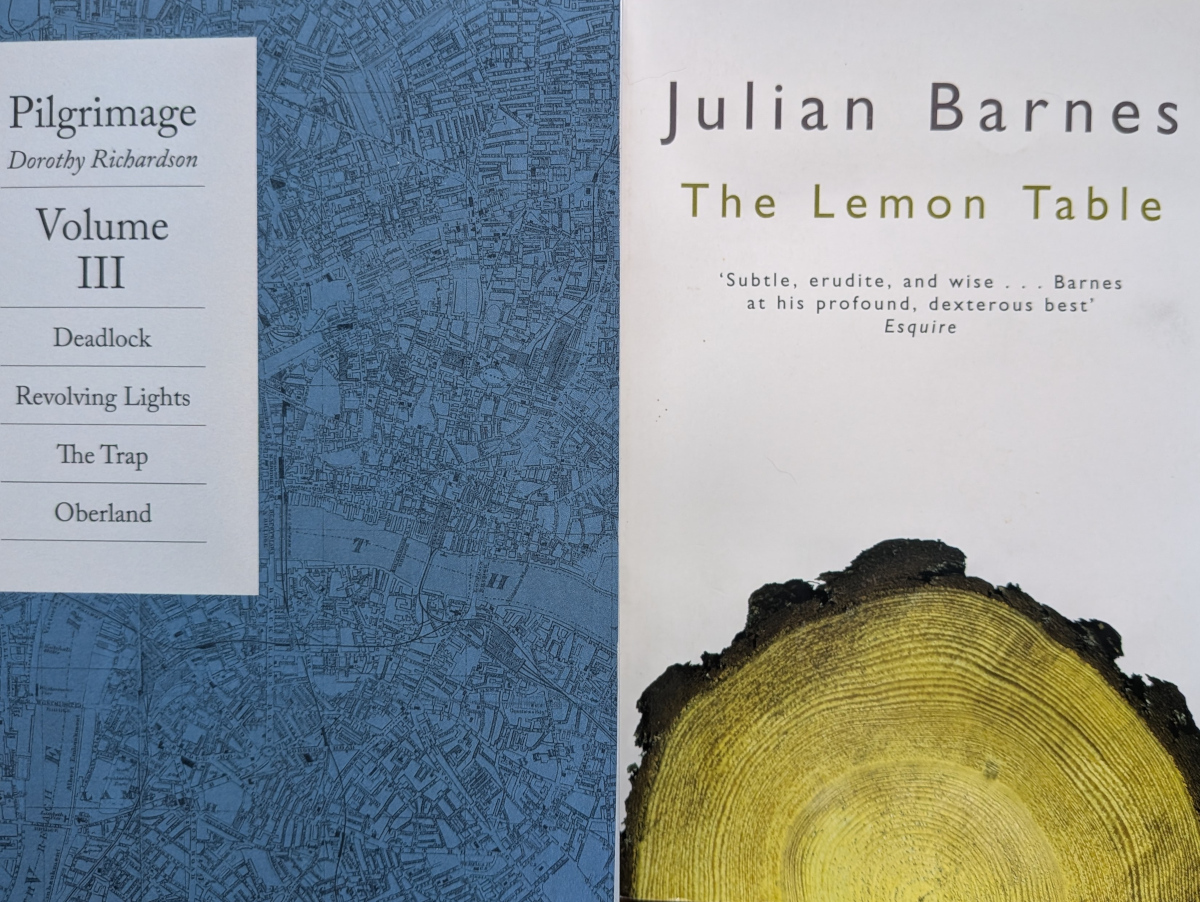
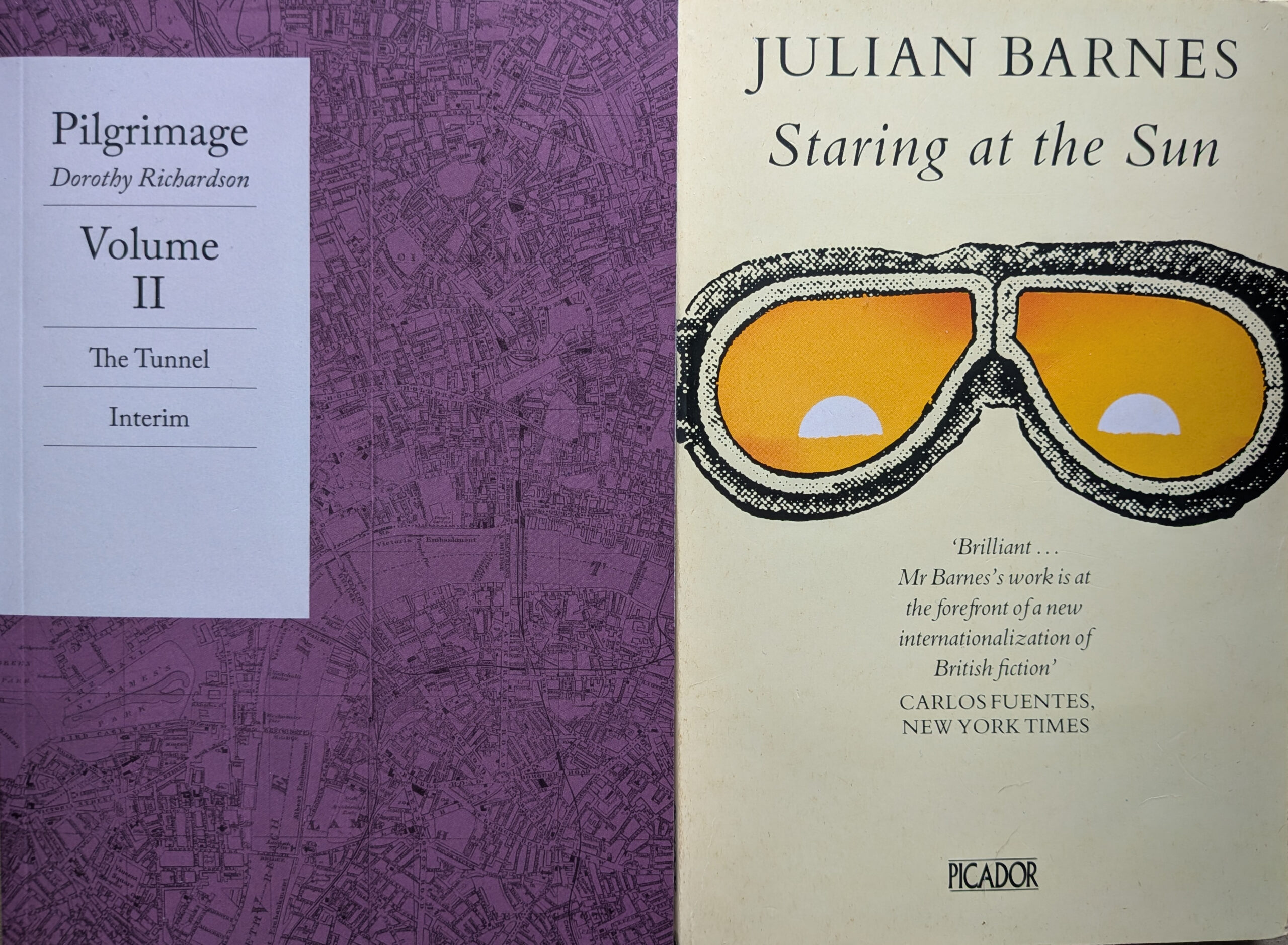
Covers of Dorothy Richardson's The Tunnel and Interim (in one volume), and Julian Barnes' Staring at the Sun.
  • The Tunnel — Dorothy M. Richardson
  • The Midnight Timetable — Bora Chung, tr. Anton Hur
  • Über die Berechnung des Rauminhalts III — Solvej Balle, tr. Peter Urban-Halle
  • The Tokyo Suite — Giovana Madalossa, tr. Bruna Dantas Lobato
  • Staring at the Sun — Julian Barnes
  • Über die Berechnung des Rauminhalts IV — Solvej Balle, tr. Peter Urban-Halle
  • Money to Burn — Asta Olivia Nordenhof, tr. Caroline Waight
  • A New Name — Jon Fosse, tr. Damion Searls
  • Interim — Dorothy M. Richardson

Starting with the Scandinavians, I read volumes three and four of Über die Berechnung des Rauminhalts (On the Calculation of Volume). The story itself is progressing in very interesting directions, though Tara’s/Balle’s verbal tics are increasingly irritating when one reads two volumes per month. Volume four spends a lot of time recounting endless meetings, which is as exciting as one might expect. All of which means that each volume since the first has been progressively worse, though they’re still pretty good. And she does excellent cliffhangers.

Another Danish septology still in progress begins with Money to Burn, which wasn’t quite what I was expecting. It’s a short, (artfully) messy story of the kind of messy, fucked-up lives we tend not to associate with Scandinavia, tangentially linked with the ostensible centrepiece of the series, the Scandinavian Star disaster/scandal. On which subject, as the narrator says, “If there’s anything rare about this case, it is only that the victims of capitalism (assuming we ignore the ones not even counted as victims: plants, insects, fungi, fish) aren’t usually located in Scandinavia.” So surprises all round.

Not so many surprises in A New Name, the last instalment (of two books) of Jon Fosse’s Septology. This is basically the same as the previous books, the repetition here being very definitely the point. Disappointingly the excellent German audiobooks only cover the first two instalments, so I had to settle for reading the English translation. It was disconcertingly different (slangy American English and odd capitalisation, which I assume reflects the original but obviously didn’t affect the audiobooks).

The Midnight Timetable was my only book of short stories this month: a series of (sort-of) ghost stories with a mildly SF bent. The setting which links them together is occasionally ropey, but gives it a satisfying togetherness nevertheless.

Another Portuguese in Translation book club book this month: The Tokyo Suite didn’t bowl me over, I suspect because the short chapters created a lack of focus. Further confusion arose because the two voices in the book are distinguished in part by the linguistic mistakes which one character makes, but some poor production means that there are quite a few similar accidental mistakes in the other chapters too. The discussion was at least interesting, and the author mentioned that her first book was “much darker”, which I take as a recommendation.

And the ongoing projects: two volumes of Dorothy Richardson (The Tunnel and Interim), where she’s much more linguistically inventive and wilfully obscure than in the opening “trilogy”. Interim has the best example so far of her characteristic repetition:

Two tall vases on the mantelshelf holding dried grasses carried her eyes up to two short vases holding dried grasses standing on the wooden-pillared brackets of the overmantel, and back again to themselves.

This month’s helping of Barnes was Staring at the Sun, which I first read thirty or so years ago. Very good, very funny, very humane, and with a marvellously retro version of Chatgpt in the final section. What more could one wish?

Next month’s theme is a work-in-progress, but may be a revival of my planned European tour which never quite happened….

Posted in Books | Comments Off on Reading List May 2026

Reading List April 2026

I finished eight books in April, four from the International Booker longlist (plus one former); four by women/POC and a feeble one in German.

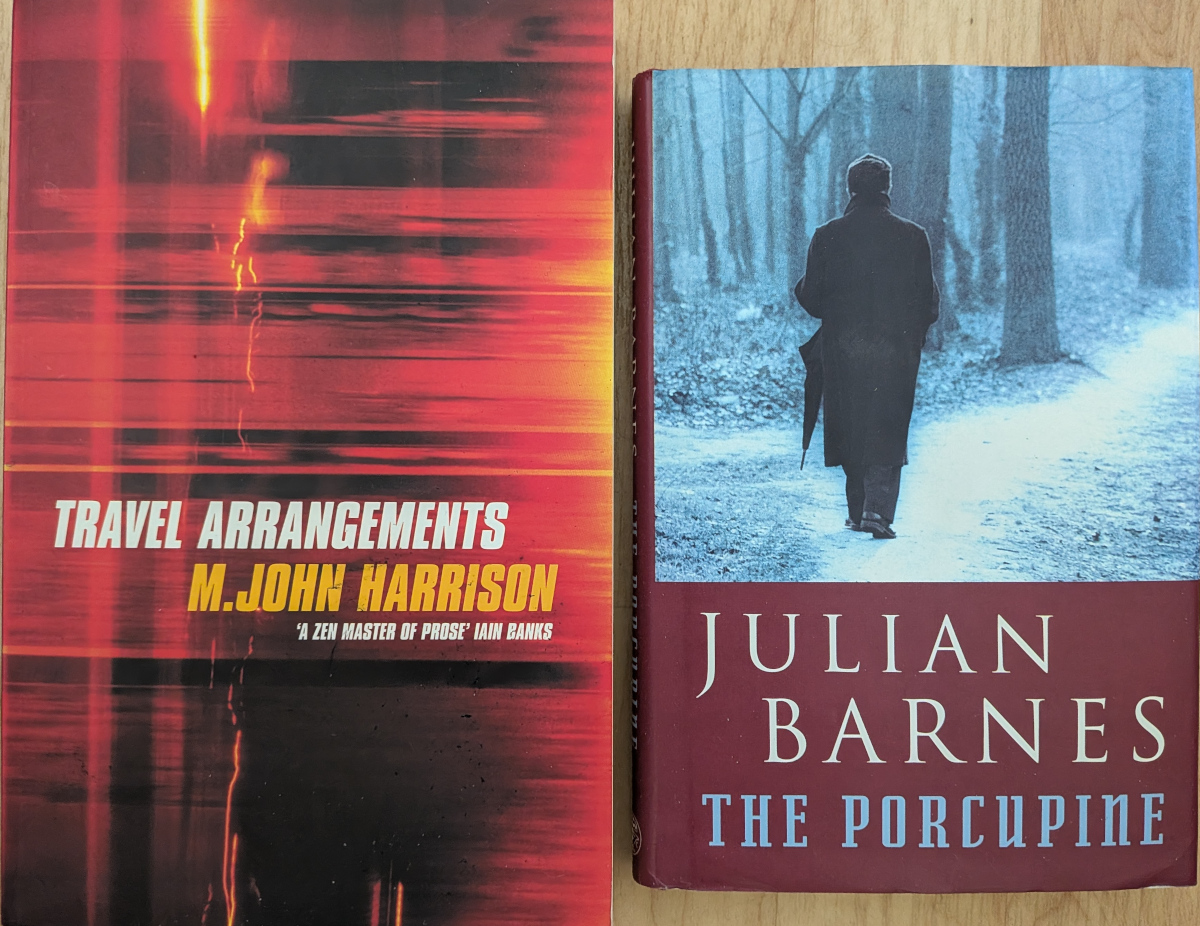
Covers of Travel Arrangements and The Porcupine.
  • Lichtspiel — Daniel Kehlmann
  • Taiwan Travelogue — Yang Shuang-zi, tr. Lin King
  • The Deserters — Mathias Énard, tr. Charlotte Mandell
  • On the Calculation of Volume II — Solvei Balle, tr. Barbara J. Haveland
  • She Who Remains — Rene Karabash, tr. Izidora Angel
  • The Ladies of Grace Adieu and Other Stories — Susanna Clarke
  • The Porcupine — Julian Barnes
  • Travel Arrangements — M. John Harrison

Lichtspiel was one of the best longlisted novels for me (along with the Shida Bazyar). There’s a gimmicky ending, which is a big negative, but the portrayal of Pabst is touching and believable, and the Nazis are brilliantly done, with a terrifying mix of charm and random violence. I now want to see the films themselves, so it worked on me.

I wasn’t so keen on the other three. The Deserters is also set largely in Germany, and is overshadowed by the war, but I found the two story threads each too slight to really interest me. I missed the humour of The Annual Banquet of the Gravediggers’ Guild; now I’ve no idea what kind of a writer Énard actually is, I need to read more!

Taiwan Travelogue was disappointing. The printed version includes some metafictional apparatus which should put the story in an interesting context, but for some reason this was omitted from the audiobook (and the narrator did not help matters). The political side managed to be underexploited and crashingly obvious, which is quite the combination.

Last of the four was She Who Remains, which I also didn’t like. The first part in particular is a Kadaresque honour code story in an unremittingly bleak world, the twist being the gay/trans aspect with which it is entwined. Unfortunately Karabash pathologises this in a rather offensive and reductive way.

Solvej Balle was shortlisted for the first volume of On the Calculation of Volume; part 2 is not quite so good, as repetition creeps in to the writing rather than just the events. It’s hard to judge whether this is Balle writing poorly (spinning it out to seven volumes!), or whether we should take is as Tara’s shortcoming, but either way it’s not great to read. The development of the idea make continuing worth it however, and there’s a splendid reveal at the end.

The Barnesathon continued with The Porcupine, which I first read when it came out 30+ years ago. There’s lots of lovely writing I’d forgotten, so well worth reading even if not one of his deepest. The central character, like Kehlmann’s Nazis, has a lovely balance of charisma and horror.

Finally, two books of short stories which each set memory bells constantly ringing. The Ladies of Grace Adieu and Other Stories is effectively an appendix to Clarke’s Jonathan Strange and Mr Norrell, which is no bad thing. I kept thinking I’d read parts before, and I’m still not sure whether I had, or it was because they reminded me of the novel. The audiobook is also excellently performed.

Travel Arrangements definitely does repeat material which is worked out differently in some of Harrison’s other works, as is his way. Often baffling, but poetic, funny, and overall an enjoyably weird collection.

I haven’t finished this month’s volume of Pilgrimage (The Tunnel — a big one), so there should be two next month, along with — if it goes according to plan — at least three books for my very normal topic of Scandinavian septologies.

Posted in Books | Comments Off on Reading List April 2026

Reading List March 2026

I finished 8 books in March: 5 for my month’s topic of South America, 2 for my failed topic of 1983 BYBN, 5 by women/PoC, and one each in German and Portuguese.

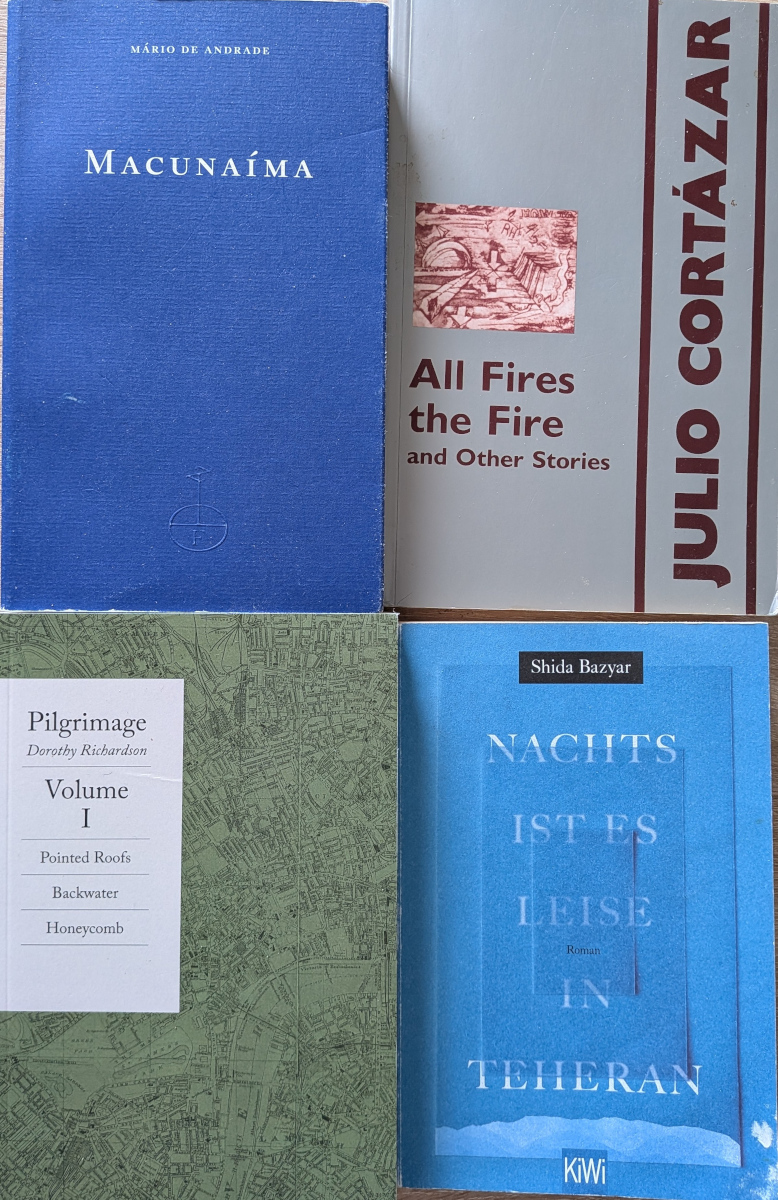
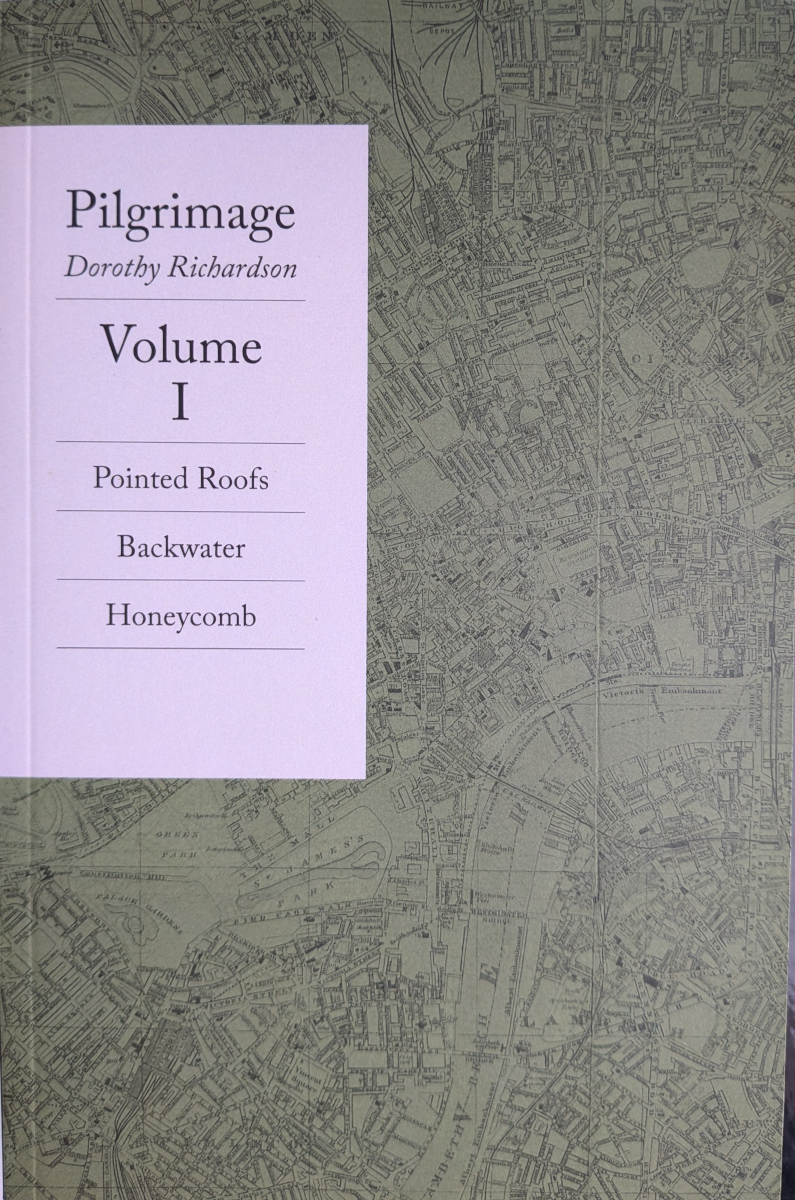
Covers of Macunaíma, All Fires the Fire, Pilgrimage volume 1, and Nachts ist es leise in Teheran.
  • All Fires the Fire — Julio Cortázar, tr. Suzanne Jill Levine
  • Little Eyes — Samanta Schweblin, tr. Megan McDowell
  • Indoctrinaire — Christopher Priest
  • Macunaíma — Mário de Andrade, tr. Katrina Dodson
  • Assim na terra como embaixo da terra — Ana Paula Maia
  • Honeycomb — Dorothy M. Richardson
  • Nachts ist es leise in Teheran — Shida Bazyar
  • Flaubert’s Parrot — Julian Barnes

Accidentally, five of the books were also re-reads, which partly explains why I got through so many (Cortázar, Schweblin, Priest, Richardson, and Barnes). All Fires the Fire is also the only book of short stories finished this month (I’m also gradually re-reading Lydia Davis’s), which has one of my favourite stories ever — The Southern Thruway, which combines a Ballardian societal collapse with another collapse/return to normality.

Little Eyes is one of my favourite books full stop, combining plausible technology with a devastating critique of the flaws in human natures which it exposes and allows to flourish. The diversity of stories contained in such a short book is impressive.

Indoctrinaire is an interesting, but not great book by a great writer: the surreal cruelty of the Brazilian section now looks like a harbinger of early Banks, while the later part is reminiscent of Priest’s own Wellesian The Space Machine.

The other two South American books were first-timers: Macunaíma was sitting in a pile for some time before it fortuitously became one of the Portuguese in Translation book group selections. No author this time, but theere was a fascinating discussion with Katrina Dodson. The book itself is completely different from what I’d expected: rather than a serious national epic, I got a collection of folk tales somewhat tenuously linked by the adventures of the “hero” (of questionable morals). “Broke all to smash” has now entered my vocabulary.

Assim na terra como embaixo da terra was also a quasi-involuntary selection: its English translation is longlisted for this year’s International Booker, so I thought I should read it in the original. I’m quite happy I did: the author’s obsession with systems of violence is not one I particularly share, but I enjoyed the complexity of the characters (and the language practice).

Nachts ist es leise in Teheran is another whose translation has been longlisted, and is also timely for other obvious reasons. Bazyar is a really good writer, bringing the characters and settings brilliantly to life. Minus one point for the dream sequences, plus ten for the conclusion.

Finally, two re-reads from my year’s series: Honeycomb is volume 3 of Pilgrimage, and makes a nice end to the trilogy of Miriam’s attempts at being a teacher before she moves to her natural home of Bloomsbury. It’s full of her trademark repetitive descriptions and splenetic outbursts, mostly this time directed at all men:

the strange, beautiful, beautiful long wide hang of the faintly patterny faintly blue curtains covering the whole of the window space

How utterly detestable mannishness is; so mighty and strong and comforting when you have been mewed up with women all your life, and then suddenly, in a second, far away, utterly imbecile and aggravating with a superior self-satisfied smile because a woman says one thing one minute and another the next. Men ought to be horsewhipped, all the grown men, all who have ever had that self-satisfied smile, all, all, horsewhipped until they apologise on their knees.

Flaubert’s Parrot is the perfect Julian Barnes book, and interestingly similar to his more recent ones: a blend of fact and fiction, with an ageing, flawed narrator grappling with failures of memory and with a fine line in irony. It’s also liable to send me back to Flaubert, as soon as I find time.

Next month, though, should be more International Booker longlistees (and perhaps some other Booker books around Mr Barnes).

Posted in Books | Comments Off on Reading List March 2026

Reading List February 2026

I finished 6 books this month, all of which fit more or less into my month’s theme of favourite writers, four by women/POC, and two in German. Portuguese might restart in March.

cover of the first volume of Pilgrimage, by Dorothy Richardson
  • The Silver Thorn — Hugh Walpole
  • Bannmeilen — Anne Weber
  • The Sad Part Was — Prabda Yoon, tr. Mui Poopoksakul
  • Backwater — Dorothy M. Richardson
  • Elizabeth Finch — Julian Barnes
  • Die Geschichte des verlorenen Kindes — Elena Ferrante, tr. Karin Krieger

The choice of theme was mainly because I’d already committed to two of my favourites (Richardson for a book group, and Barnes because I accidentally read one of his last month and felt like continuing); also because I’d almost finished the Walpole. This was the first of his books I’ve read, mainly because I’d never heard of him before, but he’s fantastic (at least in these stories). They’re mostly of a similar type: wryly comic about middle-class Brits of the interwar period, with an irony that makes the navel-gazing go down easier.

Backwater is the second volume of Pilgrimage, and sees Miriam stuck in a north London which she, in her snobbish middle-class way, looks down on. The frankness with which Richardson portrays her often ridiculous 18-year-old alter ego is one of the great things about the book which I didn’t properly pick up on the first time. It’s full of extraordinary moments, possibly the best of which being:

Miss Meldrum and Miss Stringer, the two bald Scotch chemists who went out every evening to look for a comet, the pale frowning girl from Plaistow with her mad-eyed cousin whose grey curls bunched in a cherry-coloured velvet band seemed to say “death—death” to Miriam more dreadfully out here amongst the greenery than when she suddenly caught sight of them at table, sat disconnectedly in chairs behind the squatters on the grass.

The bald Scotch chemists not even being the most extraordinary description in the sentence is what really makes it.

To the Barnes: Elizabeth Finch is not his best book: as the reviews I read noted, Elizabeth Finch herself doesn’t come across as the intellectual colossus the narrator thinks she is. That of course may be part of the point: he’s a typically Barnesian slightly bumbling protagonist, which allows writer and reader to maintain an enjoyable (ironic, British) distance. We’re left to consider for ourselves the significance of Julian Barnes focusing on Julian the Apostate, and the unreliability of sources and memories are given typical airings.

The other definite favourite writer was Anne Weber: Bannmeilen is labelled a “novel”, but it’s not clear how much if any of it is invented. It describes a series of walks undertaken in the banlieues north of Paris by Weber and her half-Algerian friend Thierry. The two spend much of their time in — ironic — bickering which neither she nor the reader know how seriously to take. Nothing much happens, but the depictions of the places are fascinating, from the run-down tower blocks to the hostile liminal spaces which surround them.

The other two books this month were if not quite top tier favourites, at least known quantities. The Sad Part Was is a collection of playful, postmodern stories which were always rewarding, but always something new. Special note for this brilliant bit of translation by Mui Poopoksakul:

my heart would beat like the engine of a train as it pulls into the platform, slow but deliberate, rhythmic but purposeful.

Finally, Die Geschichte des verlorenen Kindes is the last of Elena Ferrante’s Neapolitan Quartet. I’ve enjoyed them, but four is possibly more than enough. There are interesting parallels with Elizabeth Finch: both are portraits of an admired friend, with the inadequacies of the writer-narrator very much on display. This volume suffered from the first section being largely about Lenù’s marital troubles, both being less interesting in itself, and making the later return of the various Neapolitan characters confusing for someone who read the third volume some time ago. The audiobook narration was very good, however, and I’ll miss the way Eva Mattes says “Lenù”, “Ja”, and “Nein”.

I started a reread of one other favourite author — Samanta Schweblin, Little Eyes — and am starting another reread of a not particularly favourite book by another favourite author (Indoctrinaire — Christopher Priest), which will both fit nicely into next month’s intersecting themes: 1983 Granta BYBN listees and South America. Again because I’m already planning to read Macunaíma (South America) and another Barnes (BYBN). I may spend the rest of the year choosing another nine somewhat Barnes-related topics, just for fun.

Posted in Books | Comments Off on Reading List February 2026

Reading List January 2026

I finished a very modest five books this month, three by women/PoC (again = women), four for my “Dorothy Richardson and environs” theme; one German, and none in Portuguese (I’m doing some listening instead).

cover of the first volume of Pilgrimage, by Dorothy Richardson
  • Country People — Ruth Suckow
  • Professor Unrat — Heinrich Mann
  • Journey to Paradise — Dorothy M. Richardson
  • Pointed Roofs — Dorothy M. Richardson
  • Departure(s) — Julian Barnes

Starting with the inevitable, Pointed Roofs is not typical Pilgrimage — it’s a much easier read than most volumes, and along with Oberland is the non-England chapter — but it’s a very fine book, and contains the passage that made me fall in love with DR:

Someone was saying “Hi!” a gurgling muffled shout, a long way off.

She opened her eyes. It was bright morning. She saw the twist of Harriett’s body lying across the edge of the bed. With a gasp she flung herself over her own side. Harry, old Harry, jolly old Harry had remembered the Grand Ceremonial. In a moment her own head hung, her long hair flinging back on to the floor, her eyes gazing across under the bed at the reversed snub of Harriett’s face. It was flushed in the midst of the wiry hair which stuck out all round it but did not reach the floor. “Hi!” they gurgled solemnly, “Hi…. Hi!” shaking their heads from side to side. Then their four frilled hands came down and they flumped out of the high bed.

In one of her later letters to her younger sister, written when she was 72, DR remembers the original of this episode.

The 40-year-old DR has some fun with the perspective of 17-year-old Miriam:

how square and stout she looked and old, careworn, like a woman of forty.

I read some new to me Richardson too: Journey to Paradise is a miscellaneous collection of stories and sketches, some clearly adjuncts to Pilgrimage itself. One for the completists, I have to say.

Country People is by Ruth Suckow, a friend and correspondent of Richardson. It reminded me of Elizabeth Strout, or Garrison Keillor — rather matter of fact depiction of, well, country people. Once I’d got used to the gentleness of the pace it was interesting enough, but not enough to send me running for more Suckow.

Heinrich Mann is another contemporary who Richardson read and liked, so I chose Professor Unrat. This was great fun, well-narrated as an audiobook, with a central character seeming to deserve an interesting mix of pity, contempt, and admiration.

Pausing here to mention some DR-adjacent books which I haven’t managed to finish: Hugh Walpole is a great discovery, and I’ll finish The Silver Thorn next month; I haven’t got far at all with May Sinclair (Mary Olivier), Romer WIlson (Martin Schüler), or John Cowper Powys (Wolf Solent), though I do like what I’ve read of the latter two.

Departure(s) was not in the plan, but I saw that the audiobook was coming out, and grabbed. It’s classic late Barnes: combining memoir, essay, and fiction on, as he pre-emptively mentions, some of his favourite tropes. Barnes’ own narration makes it all the more powerful, fitting perfectly a book being narrated by … author Julian Barnes. A perfect ending rounds off his last words.

Next month, inspired by Julian, my topic is favourite authors: JB, DR, Anne Weber, Joachim Meyerhoff … the list is growing.

Posted in Books | Comments Off on Reading List January 2026

Reading List December 2025

A modest end to the year, with 8 books finished, 6 for my non-fiction monthly theme, and 6 also by women/POC (in this case, all just women!), 1 in Portuguese and a dismal 1 in German.

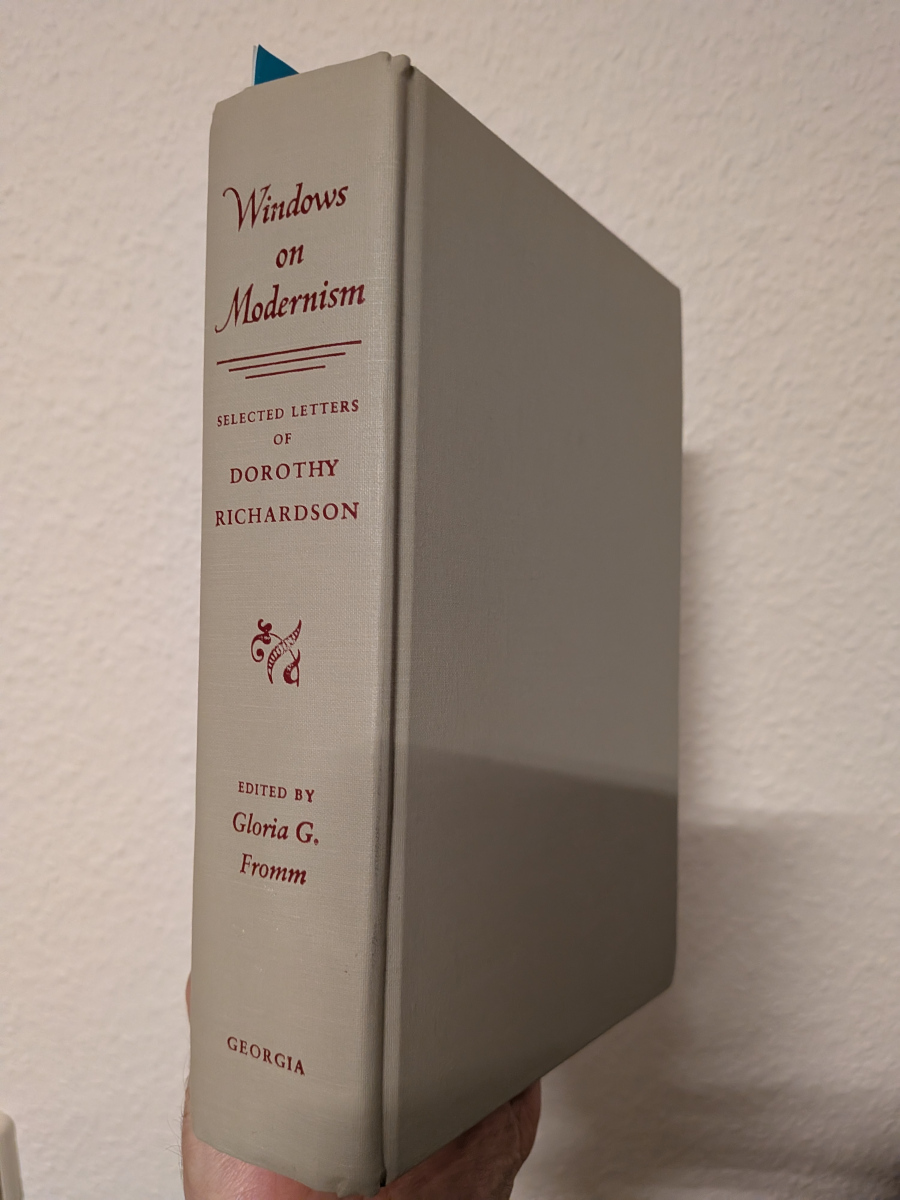
Windows on Modernism, selected letters of Dorothy Richardson, edited by Gloria G. Fromm
  • Greyhound — Joanna Pocock
  • Irgendwo — Agota Kristof, tr. Carina von Enzenberg
  • Ancestors — Alice Roberts
  • Erik Satie Three Piece Suite — Ian Penman
  • Bird Therapy — Joe Harkness
  • Windows on Modernism — Gloria G. Fromm (ed.)
  • A árvore mais sozinha do mundo — Maria Salomão Carrara
  • Shadow Behind the Sun — Remzije Sherifi

Windows on Modernism — letters by Dorothy Richardson — was the reason for the theme, and the reason why I didn’t get much other reading done (almost 700 pages). This was mainly preparation for next year’s Pilgrimagathon, and after a slow start getting to know her correspondents, I found it equally useful and enjoyable. Following the progress (or not) of Pilgrimage‘s production is fascinating, and I’ve acquired a list of writers in her circle that I want to start on next month. The experience of reading the letters is a nice parallel to Pilgrimage itself, seeing the world through the eyes of one woman! Still thinking about Henry James’s waggling backside:

To-day, meaning roughly your & my days, so many, in fact most, writers have been so consciously & laboriously literary, that in reading them- & the reading may be joy-one is so fascinated by what they are doing, technically, by tracing exactly how they get their effects, that one is tempted to paraphrase Emerson’s “What you are speaks so loudly that I cannot hear what you say” into “What you so cunningly, & successfully, are doing is so impressive, interesting, tiresome, tedious, stultifying, that meaning, what you are saying, or trying to say, is secondary.” And sometimes to add “You have really nothing to say, or are keeping back what, if anything, you want to say, in the interest of a cunning way of saying it.” This I feel most strongly in regard to Henry James; for whom Europe was too much. His style, fascinating at a first meeting for me can only be, very vulgarly, described as a non-stop waggling of the backside as he hands out, on a salver, sentence after sentence, that yes, if the words had no meaning, would weave its own spell. So what? one feels, reaching the end of the drama in a resounding box, where no star shines & no bird sings.

I also took the opportunity to read two of Fitzcarraldo’s white-jacketed non-fiction books: Greyhound is an account of three overlaid journeys from Canada to Las Vegas and California on Greyhound buses: one by Pocock post-Covid, with recollections of her earlier trip on the same route while writing a novel whose protagonist follows the same path. Pocock’s good on the suburbs:

Suburbs are environmental cosplay for folk who want to imagine themselves as farmers (those flower beds!), landowners (those decorative architectural and lawn ornaments!) or even hunter-gatherers (those steaks on the barbecue!)

but the overwhelming impression is of the squalor into which many of the places, and the buses, have descended in the interim, though some things do happen towards the end to lighten the mood.

The second Fitzcarraldo was Erik Satie Three Piece Suite, a desk-based exploration of the life and work of Satie. It’s mostly fragmentary, with an alphabetical list of people and topics followed by Penman’s diary of the project, which is a very Satiesque way of doing things. There’s a little more whimsy than I’d like (especially the dreams in the diary section), but it sent me back to the music, which is a win.

Ancestors was an audiobook which I bought dutifully some time ago and never got round to, but it turned out to be much more interesting than I’d thought. Roberts takes a series of burials (or possibly not — that’s one of her main topics) as the starting point for a wider discussion of archaeology and genetic science.

Shadow Behind the Sun is an account of the years leading up to Kosova’s independence, with a focus on Serbian atrocities and the author’s escape to, eventually, Glasgow (which partly explains the publisher residing in Dingwall). The short chapters on the burgeoning support network in Scotland are heartwarming, while the fact that similar events to today were taking place 20 years ago gives some important perspective.

The last non-fiction book, Bird Therapy, wasn’t such a success: the therapy side involved too much statement of the obvious for me, while the bird side was dominated by breathless accounts of the author’s bird-watching trips which lose something in the re-telling.

The short-stories this month were Agota Kristof’s Irgendwo, a collection of often very short texts which was mostly excellent. They share with her longer works the satirical fairytale darkness, with only a few seeming too abstract for my taste.

FInally, A árvore mais sozinha do mundo is, like all Maria Salomão Carrara’s books, very different from her others! Narrated by a tree and various household objects, it’s a story of the (mostly) woes of life as a tobacco farmer in the south of Brazil, though the unusual narrators add a well-judged element of distancing and irony. Still nowhere near as good as Não fossem as sílabas do sábado, however.

Next month will be focused on early 20th-century mostly modernists, in tribute to the beginning of the Richardson read-through….

Posted in Books, Uncategorized | Comments Off on Reading List December 2025

Cottbus Bird Census IV

I didn’t think I had any chance of beating the 80 species I saw last year in Brandenburg, but a few surprises got me up to 85 this time round. I’ve simplified my post somewhat this year, including all birds perceived, whether or not photographed or recorded, leaving out murky record shots, and following the ebird taxonomy (headings are my own).

Geese

Greylag GooseAnser anser
Greater White-fronted GooseAnser albifrons
Tundra Bean GooseAnser serrirostris

Swans

Mute SwanCygnus olor
Bewick’s SwanCygnus columbianus
Whooper SwanCygnus cygnus

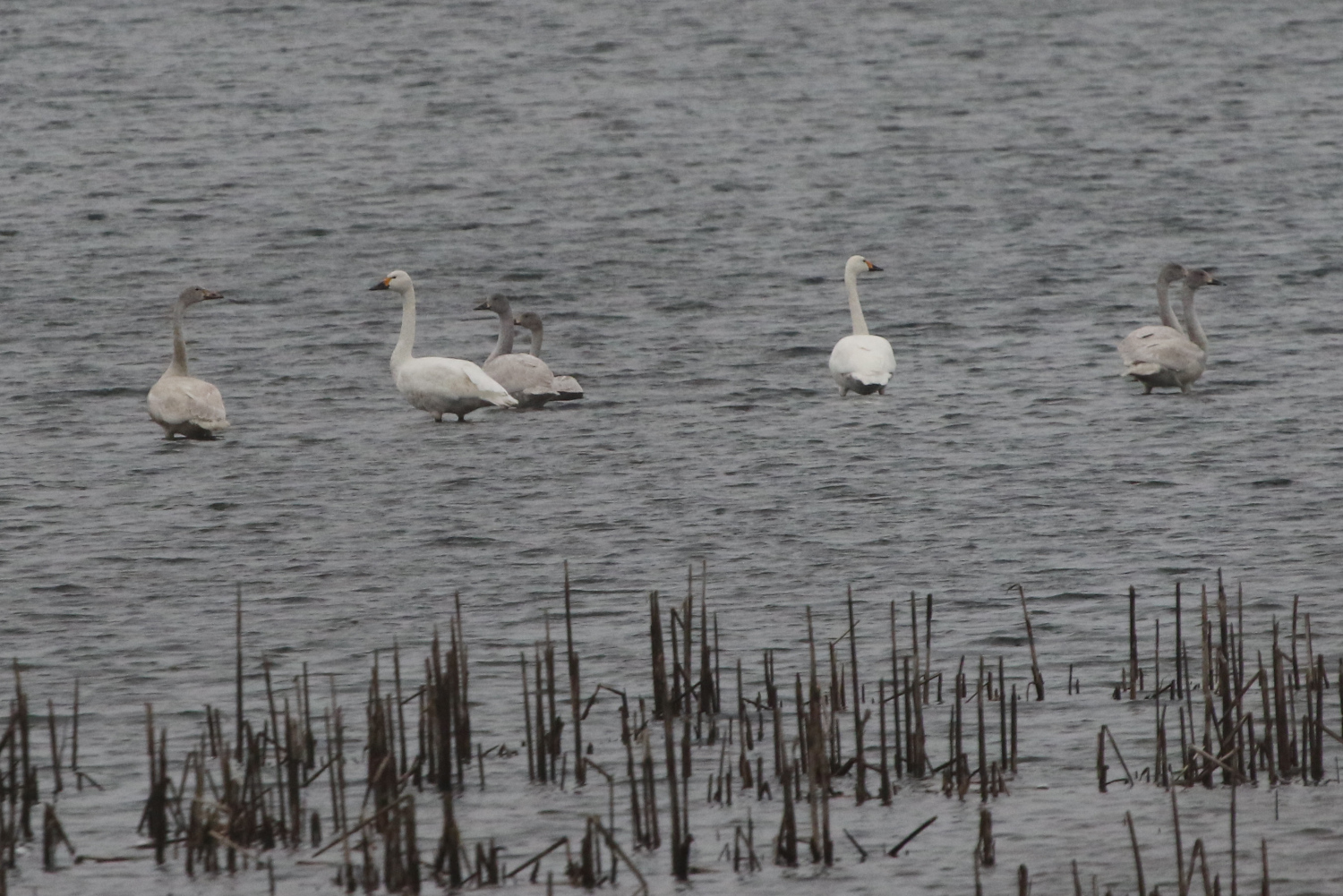
The Bewick’s were the surprise here, a (presumed) family of two adults and five young displaying themselves nicely at Wiesenteich:

Two adult and five immature Bewick's swans standing in a pond
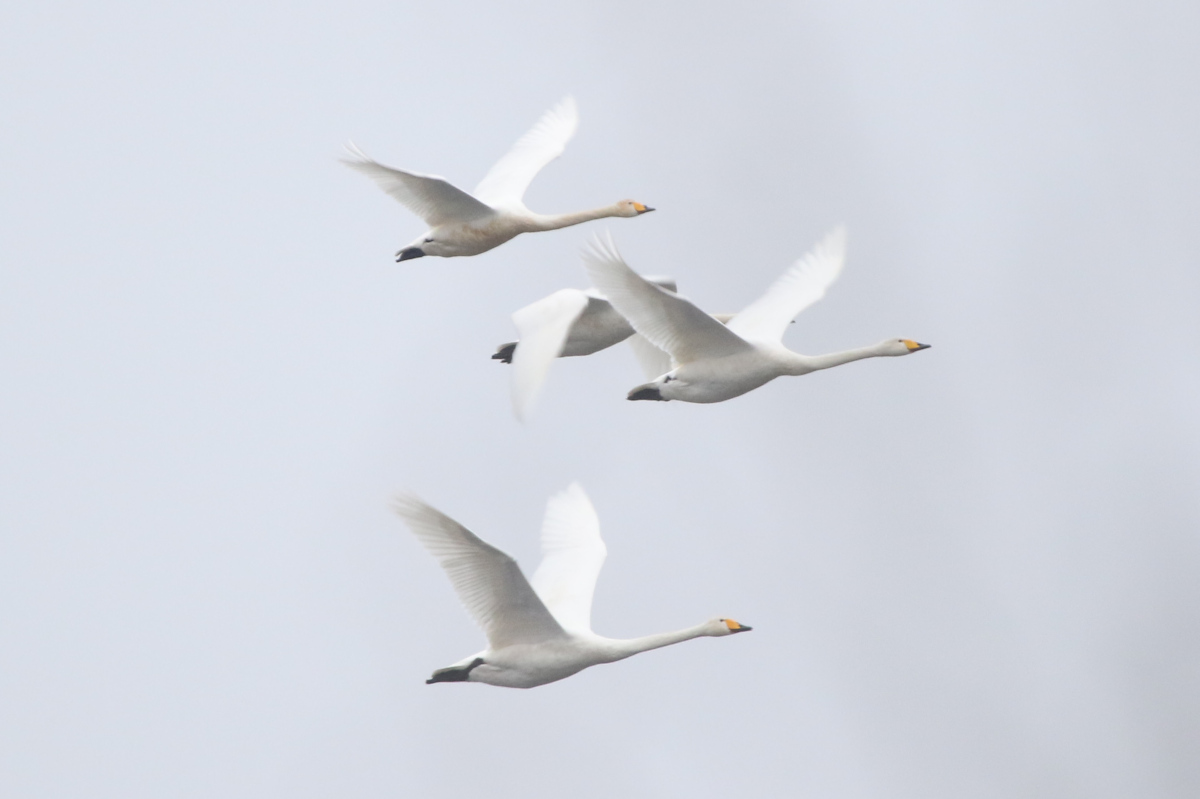
Three Whooper Swans flying in sync

Ducks

Mandarin DuckAix galericulata
GadwallMareca strepera
MallardAnas platyrhynchos
Eurasian/Green-winged TealAnas crecca
Red-crested PochardNetta rufina
Common PochardAythya ferina
Tufted DuckAythya fuligula
Greater ScaupAythya marila
Common GoldeneyeBucephala clangula
GoosanderMergus merganser

No big surprises now that we know there are fairly often Scaup on the Ostsee, apart from the Teal we encountered on a group excursion.

Incidental taxonomical surprise: Tufted Duck and Pochard are both Aythya, while Red-crested Pochard is a different genus.

A male and female mandarin swim together

Pigeons

Rock DoveColumba livia
Common WoodpigeonColumba palumbus
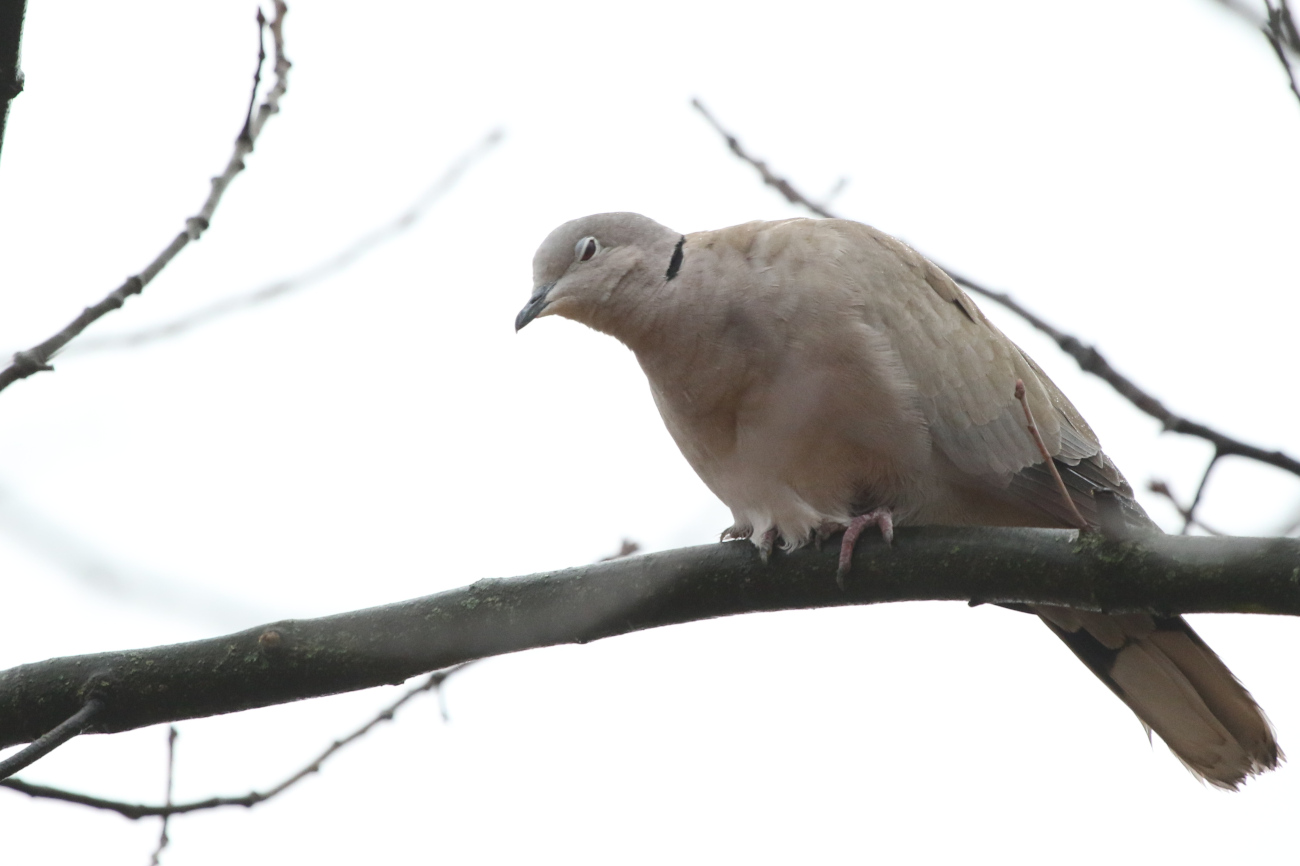
Collared DoveStreptopelia decaocto
A hung-over-looking collared dove, with half-closed eyes

Gruiformes

Water RailRallus aquaticus
Eurasian CootFulica atra
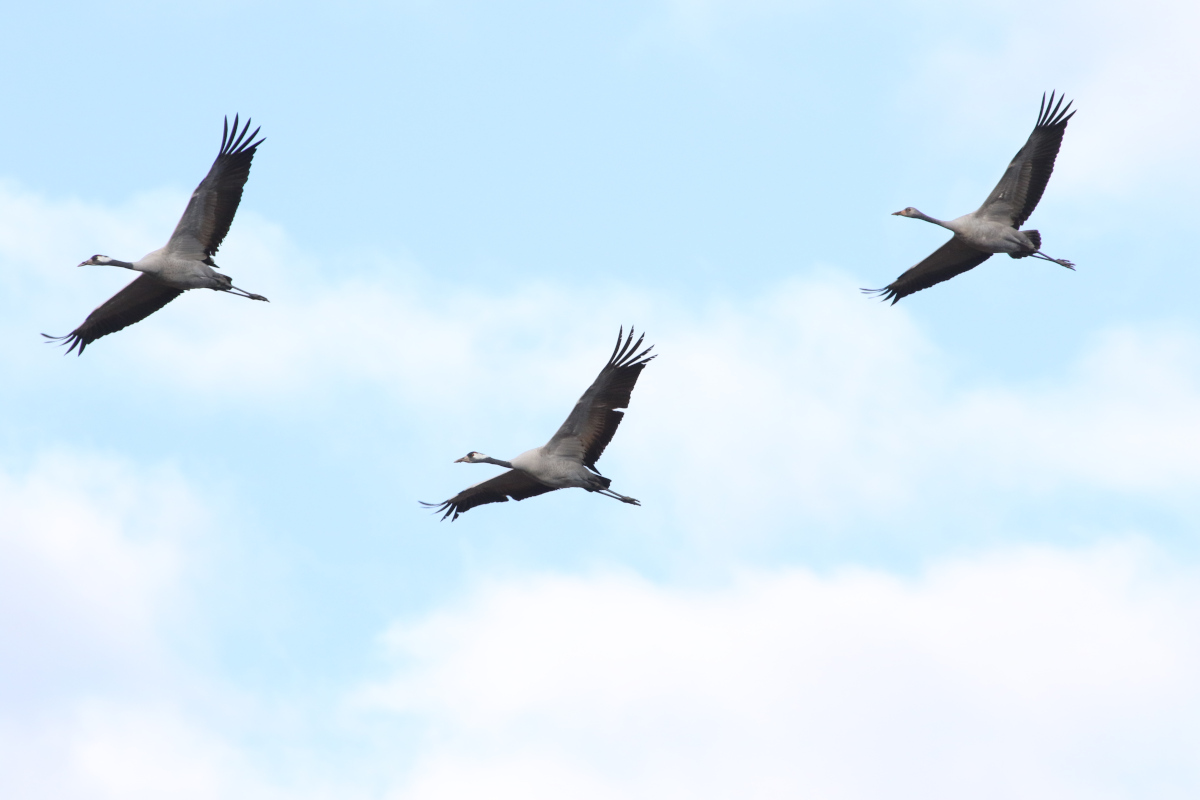
Common CraneGrus grus

Again, we now know where Water Rail can usually be heard, if never seen.

Three cranes flying with wings outstretched

Waders

Green SandpiperTringa ochropus

A nice surprise on the group excursion!

A surprised-looking green sandpiper in flight

Gulls

Black-headed GullChroicocephalus ridibundus
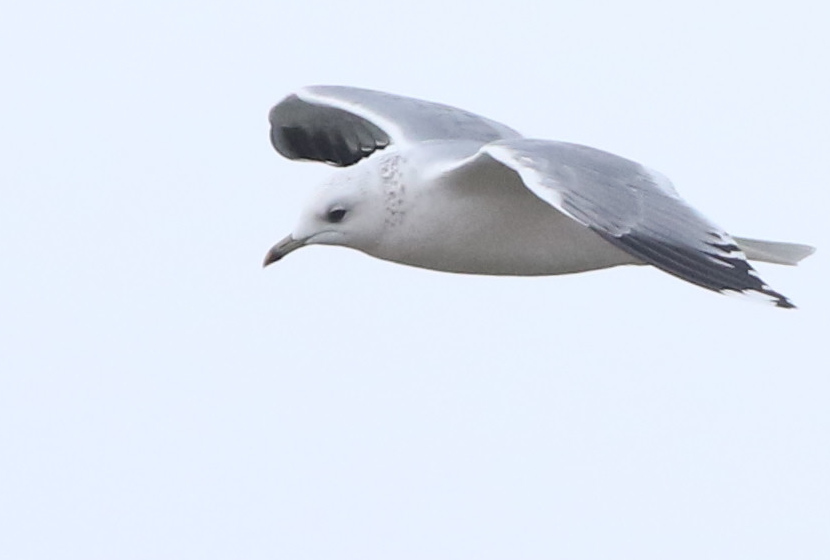
Common GullLarus canus
Caspian GullLarus cachinnans
European Herring GullLarus argentatus

The Common Gull was a nice surprise here, and good ID practice:

A common gull in flight

Grebes

Little GrebeTachybaptus ruficollis
Slavonian GrebePodiceps auritus
Red-necked GrebePodiceps grisegena
Great Crested GrebePodiceps cristatus

Slavonian and Red-necked Grebes were the standouts here, and among the nice things we’ve discovered on the Ostsee.

A red-necked grebe on the water, facing the camera

Big water birds

Great CormorantPhalacrocorax carbo
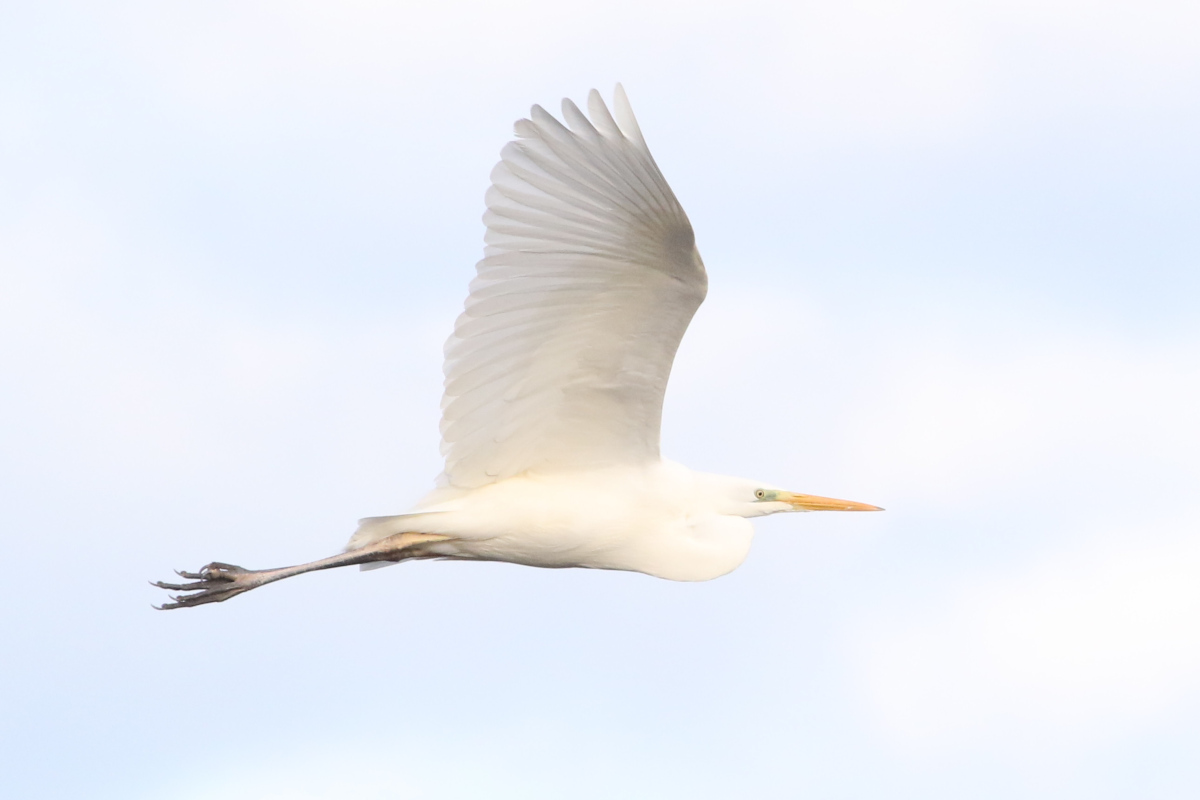
Great White EgretArdea alba
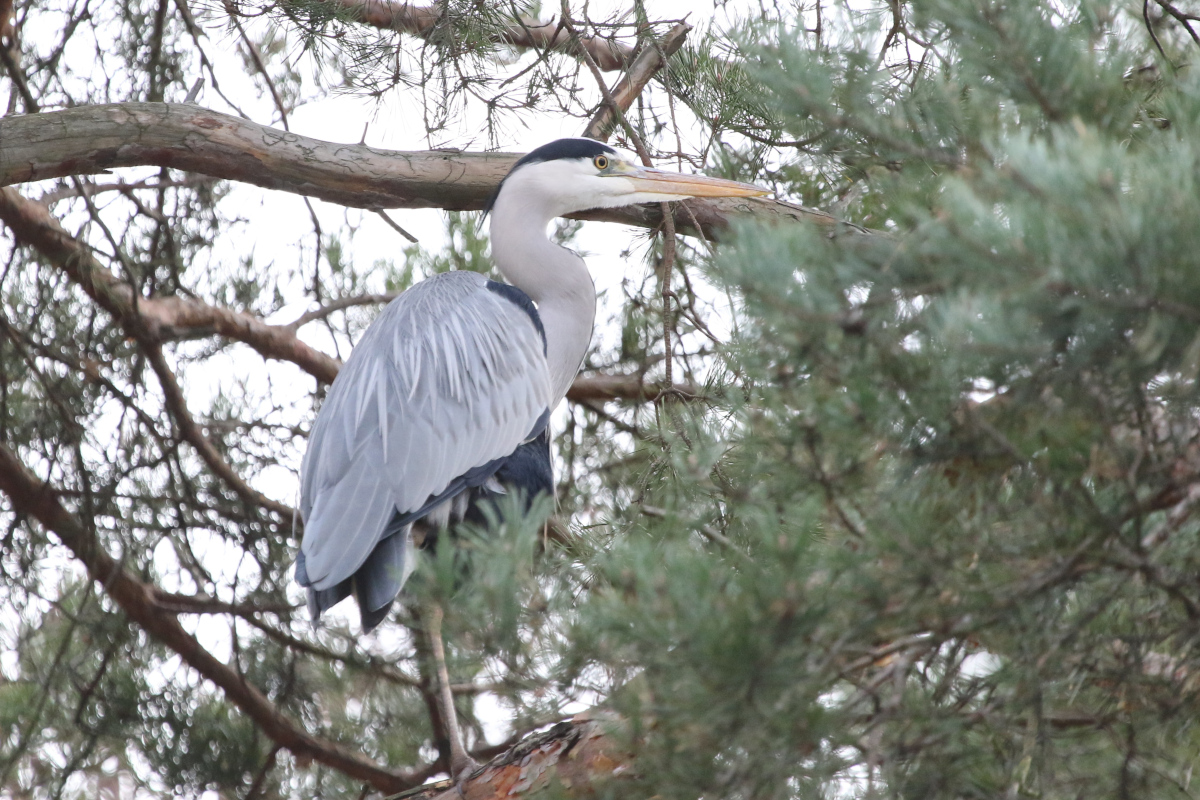
Grey HeronArdea cinerea
a great egret flying in golden light
a grey heron standing absurdly in a tree

Hawks and Eagles

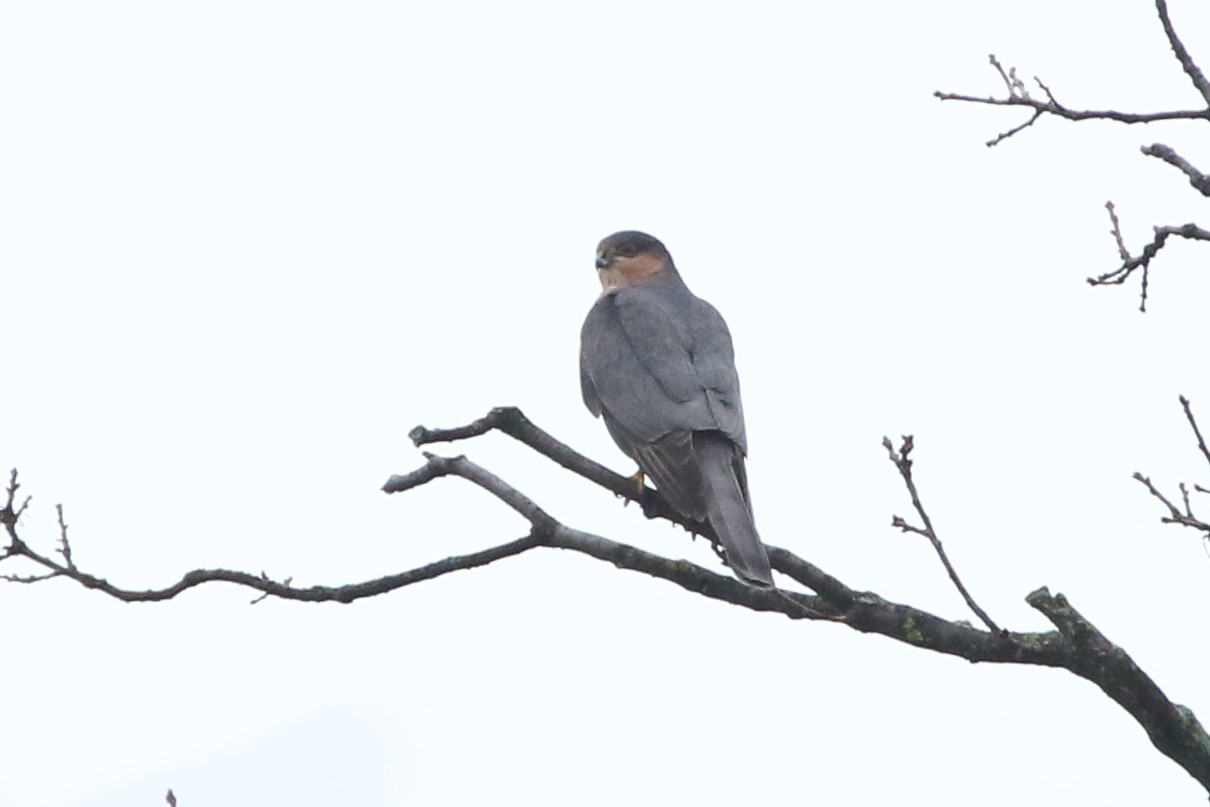
Eurasian SparrowhawkAccipiter nisus
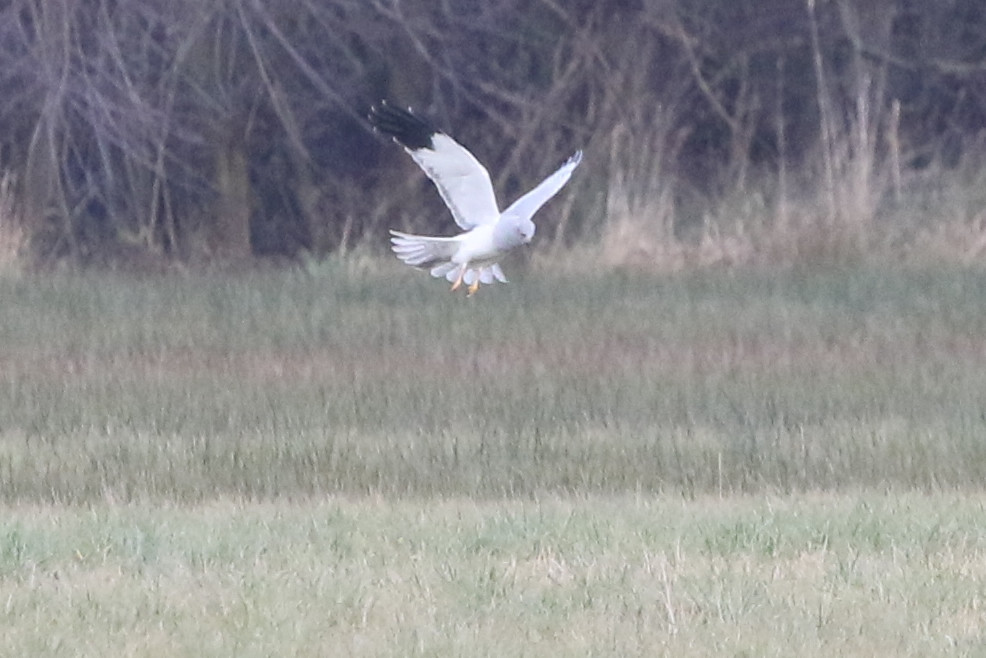
Hen HarrierCircus cyaneus
Red KiteMilvus milvus
White-tailed EagleHaliaeetus albicilla
Common BuzzardButeo buteo

We observed three hen harriers this month, probably a record; the highlight was this somewhat distant male:

a male hen harrier drifting over a field

This male sparrowhawk posed nicely:

A male sparrowhawk on a branch, looking over his shoulder

Kingfisher

Common KingfisherAlcedo atthis

Woodpeckers

Middle Spotted WoodpeckerDendrocoptes medius
Great Spotted WoodpeckerDendrocopos major
Eurasian Green WoodpeckerPicus viridis
Black WoodpeckerDryocopus martius

Pausing to note the chaos that is this set of genera.

Falcons

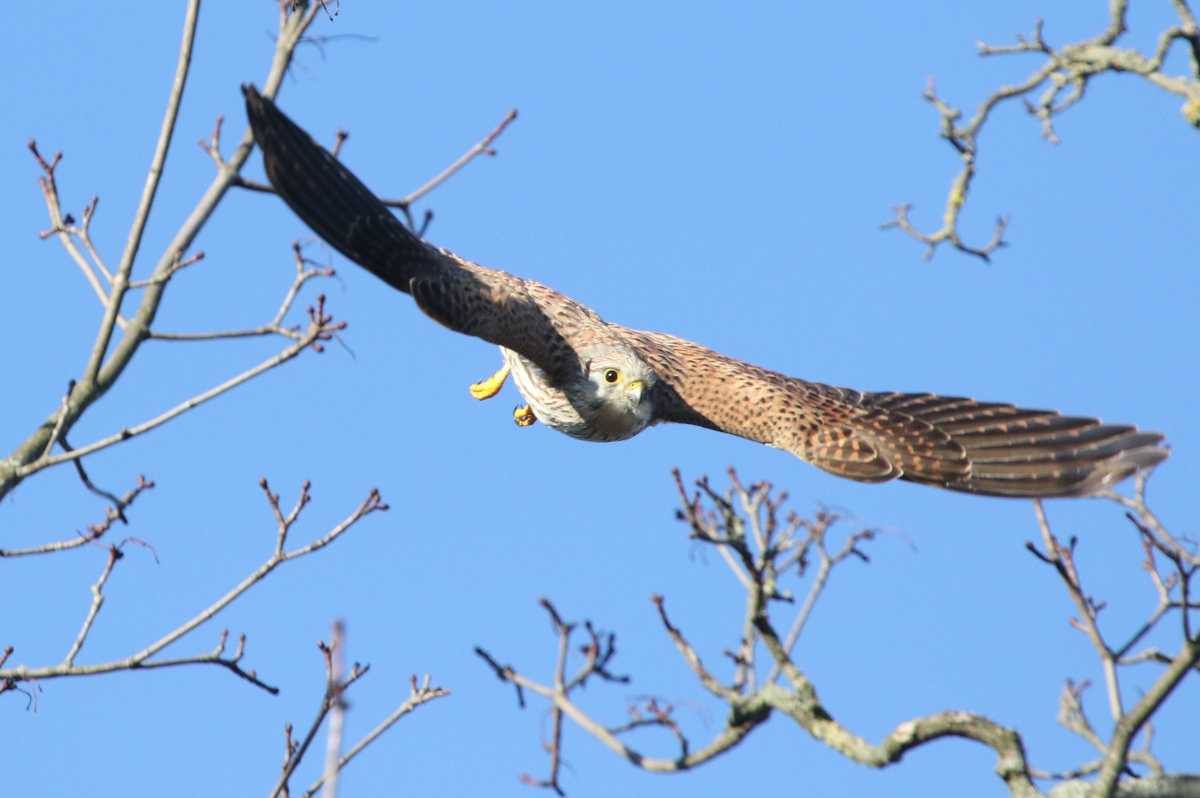
Common KestrelFalco tinnunculus
Peregrine FalconFalco peregrinus

The regular pair of Peregrines were sitting beside their nest again, very helpfully, while the most helpful Kestrel was round the corner from home:

A female-type kestrel descending from a tree

Shrikes

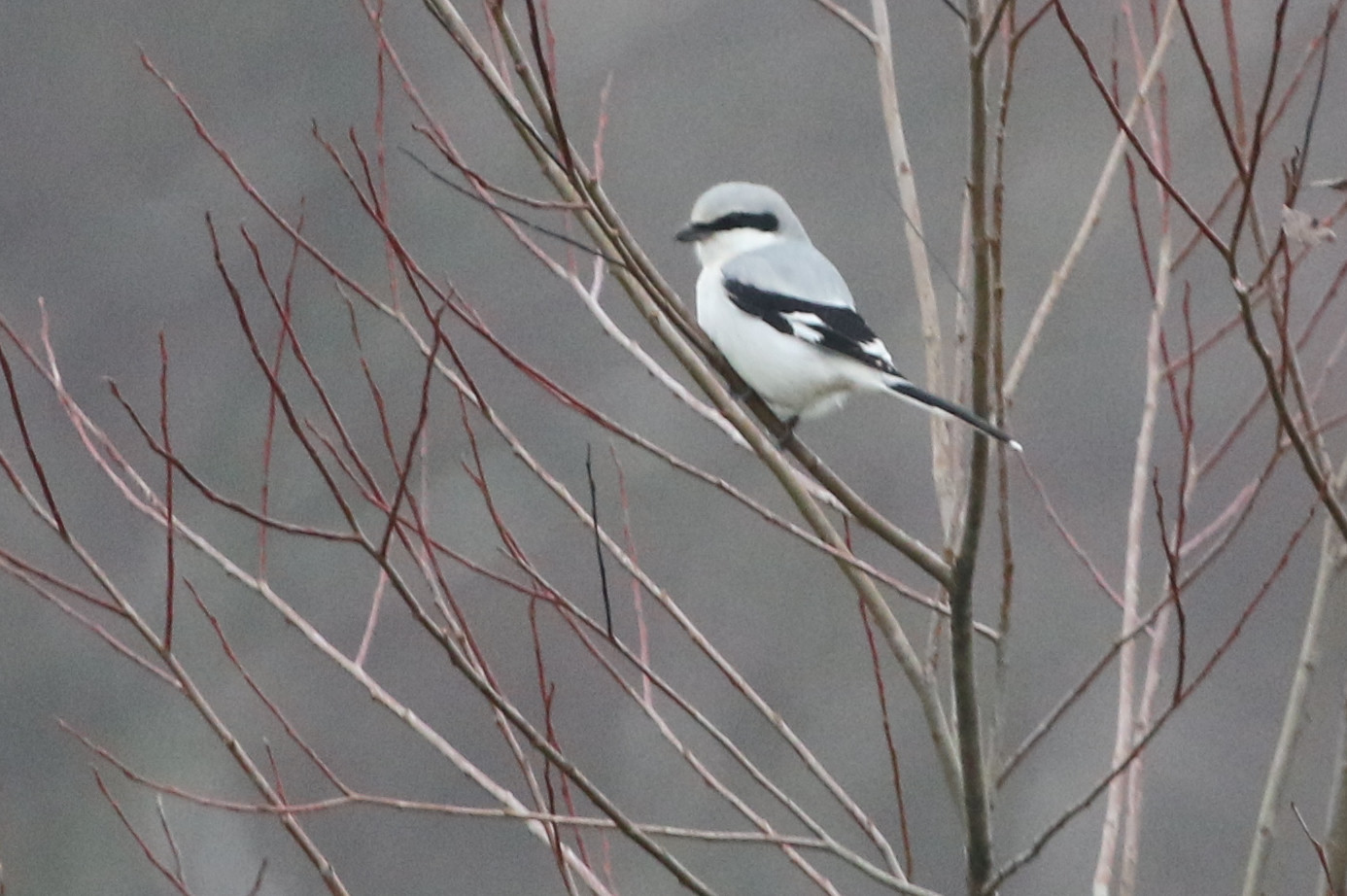
Great Grey ShrikeLanius excubitor

Another nice surprise!

A great grey shrike perched in a bare tree

Corvids

Eurasian JayGarrulus glandarius
Common MagpiePica pica
Eurasian JackdawColoeus monedula
RookCorvus frugilegus
Carrion CrowCorvus corone
Hooded CrowCorvus cornix
Common RavenCorvus corax

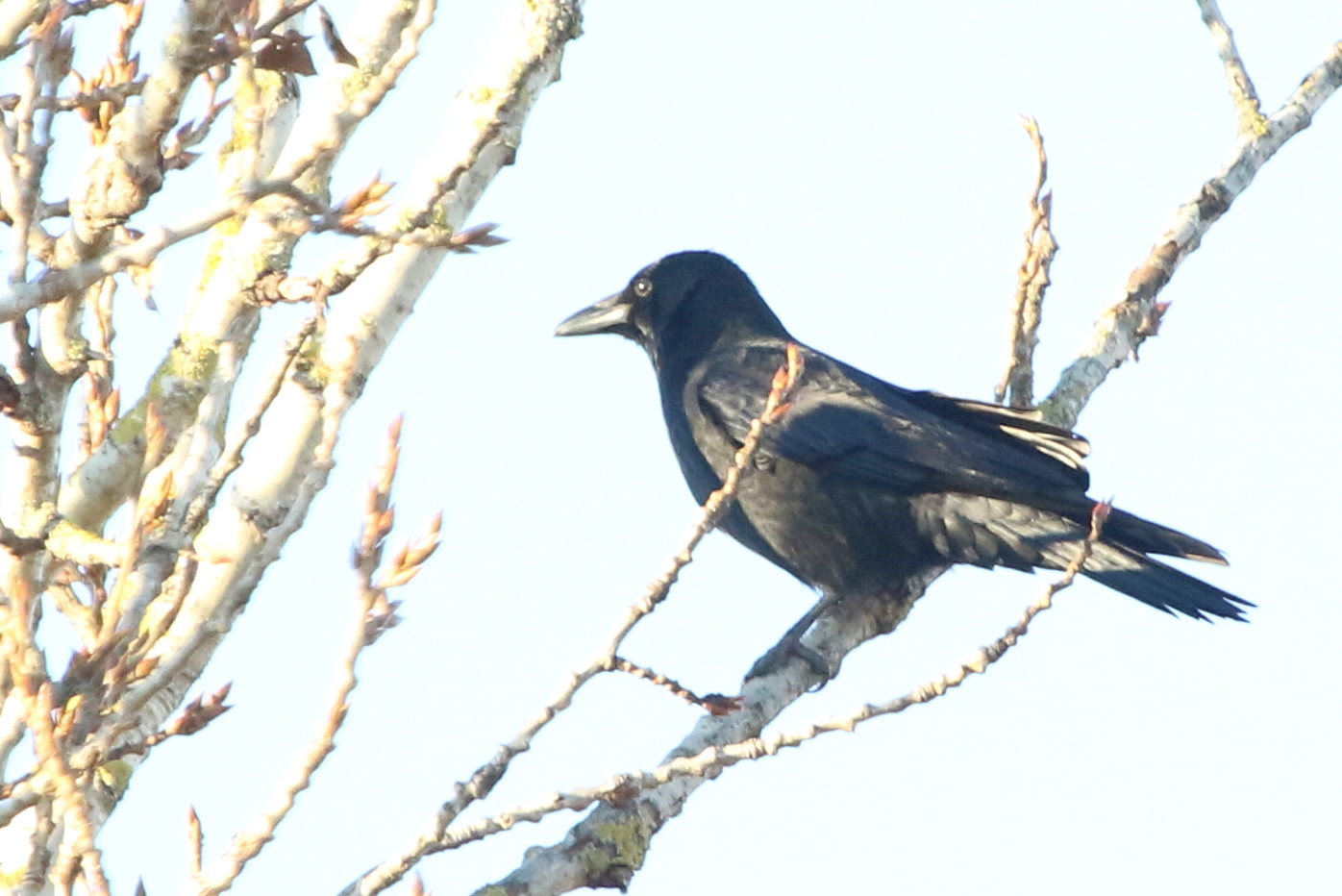
The Rooks are regular winter visitors in town, while one Carrion Crow has been living in the neighbourhood all year:

A carrion crow perched on a tree in golden light

Tits

Coal TitPeriparus ater
Crested TitLophophanes cristatus
Marsh TitPoecile palustris
Willow TitPoecile montanus
Eurasian Blue TitCyanistes caeruleus
Great TitParus major
Long-tailed TitAegithalos caudatus

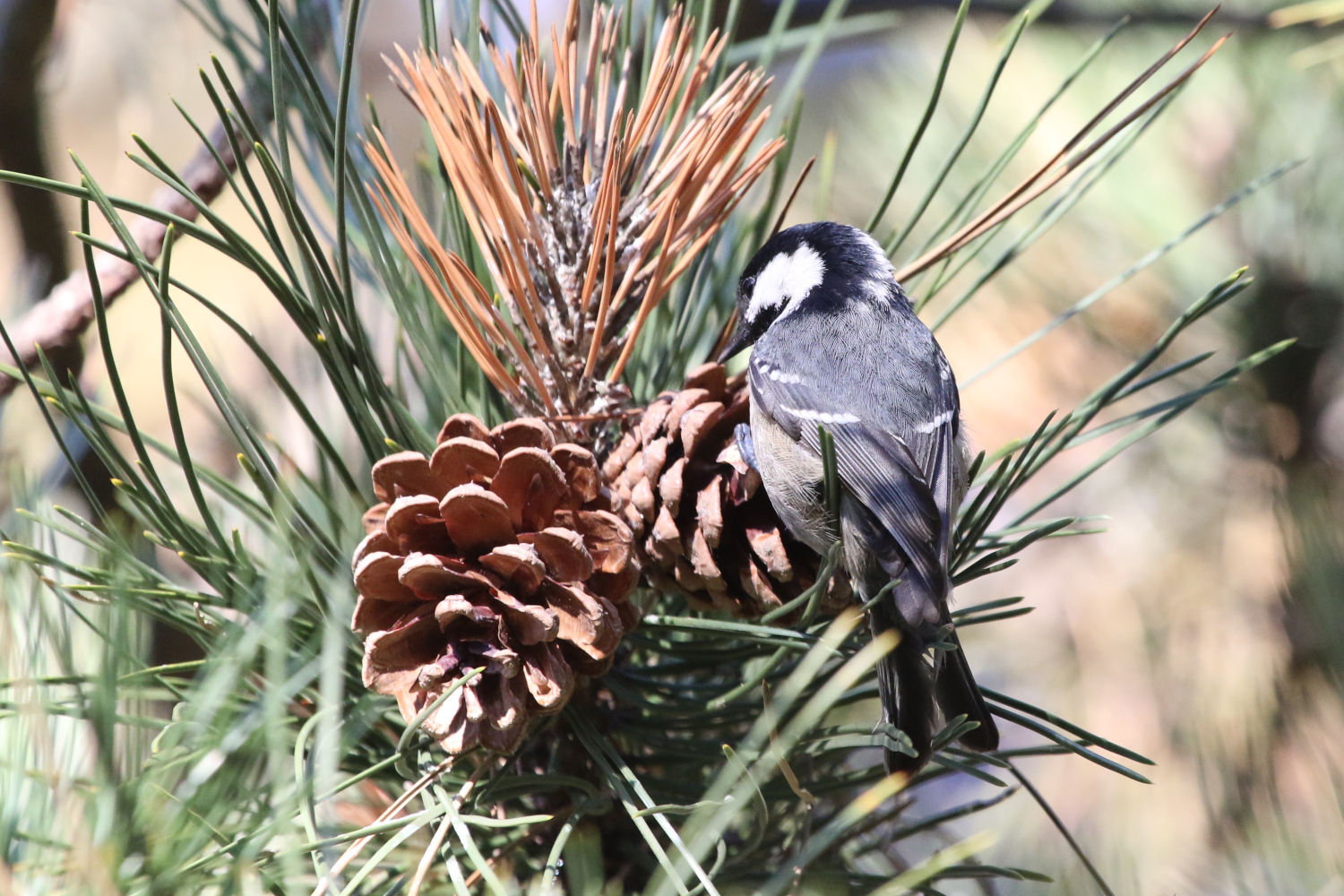
No real surprises here, now we know where Coal and Willow Tits are likely.

A coal tit planning its attack on a pinecone

Crests

GoldcrestRegulus regulus

Birds that walk in trees

Eurasian NuthatchSitta europaea
Eurasian TreecreeperCerthia familiaris
Short-toed TreecreeperCerthia brachydactyla

Miscellaneous small passerines

Eurasian WrenTroglodytes troglodytes
Common StarlingSturnus vulgaris

Thrushes

Mistle ThrushTurdus viscivorus
Eurasian BlackbirdTurdus merula
FieldfareTurdus pilaris

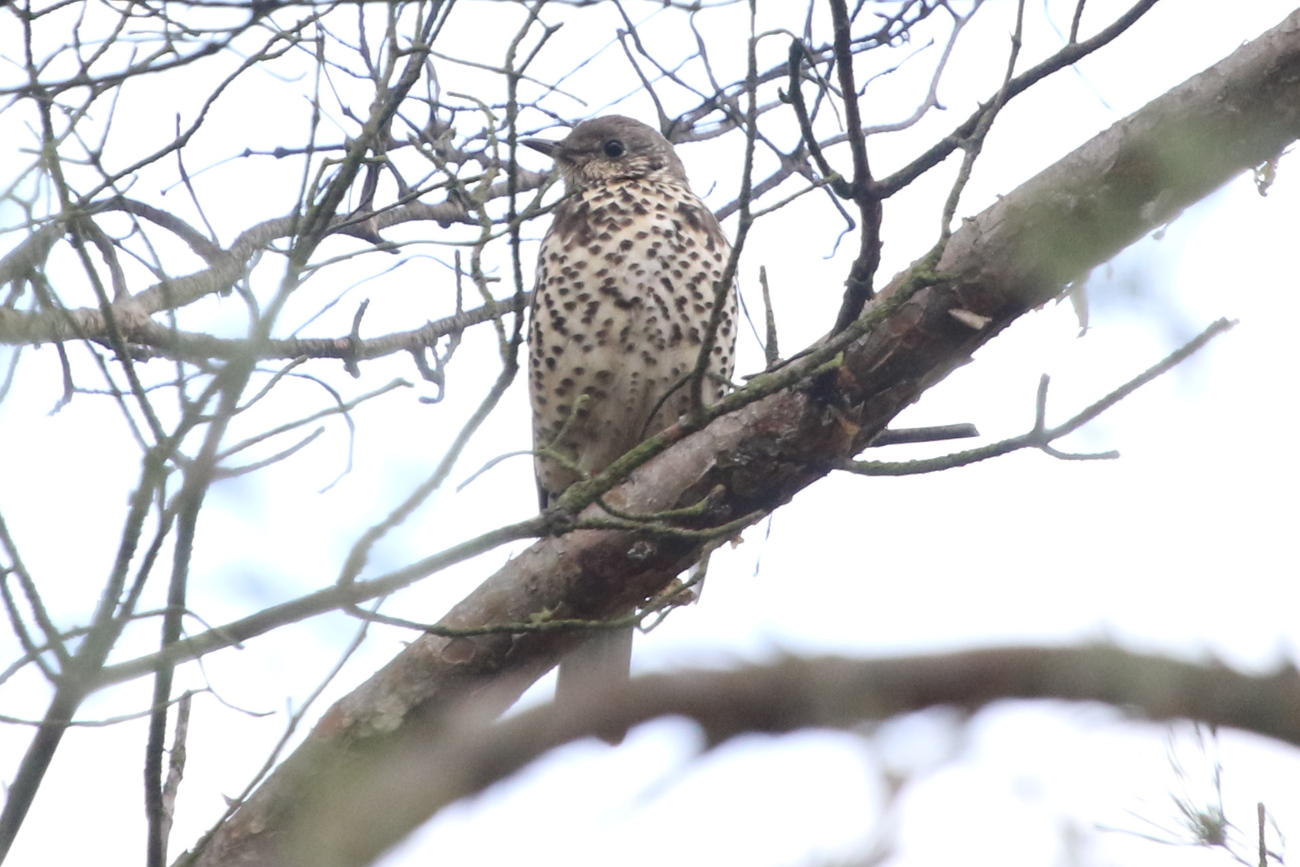
Just one Fieldfare seen this month, and the Mistle Thrush only turned up in the last few days:

A mistle thrush displaying its chest in a tree

Flycatchers

European RobinErithacus rubecula

Sparrows

House SparrowPasser domesticus
Eurasian Tree SparrowPasser montanus

Not many Tree Sparrows in our area right now, but the House Sparrows have been thriving:

A resplendent male house sparrow standing on a bush

Wagtails

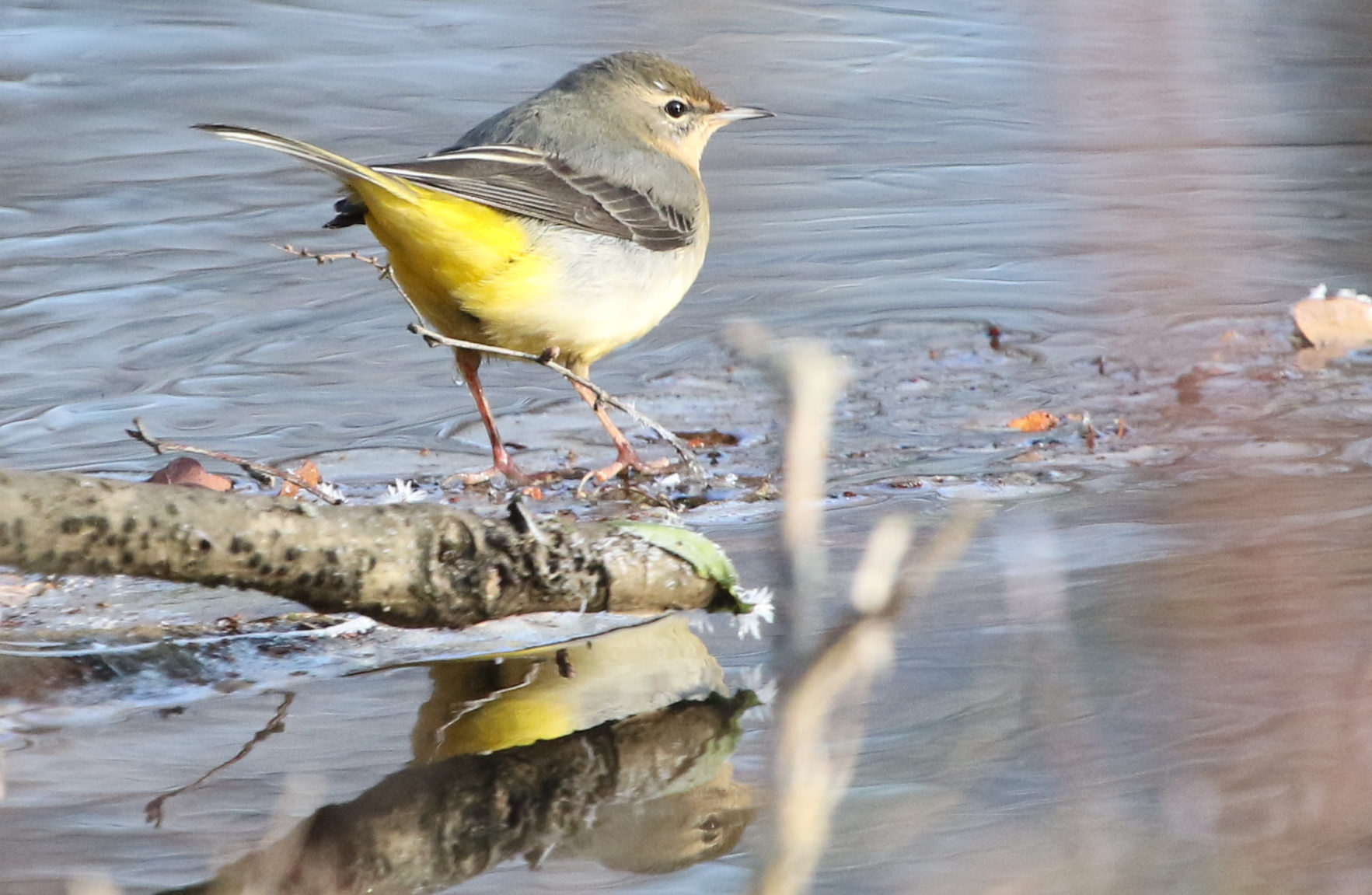
Grey WagtailMotacilla cinerea
Pied Wagtail/White WagtailMotacilla alba

Two lovely surprises!

A very yellow grey wagtail and its reflection in the river

Finches

Common ChaffinchFringilla coelebs
BramblingFringilla montifringilla
HawfinchCoccothraustes coccothraustes
Eurasian BullfinchPyrrhula pyrrhula
European GreenfinchChloris chloris
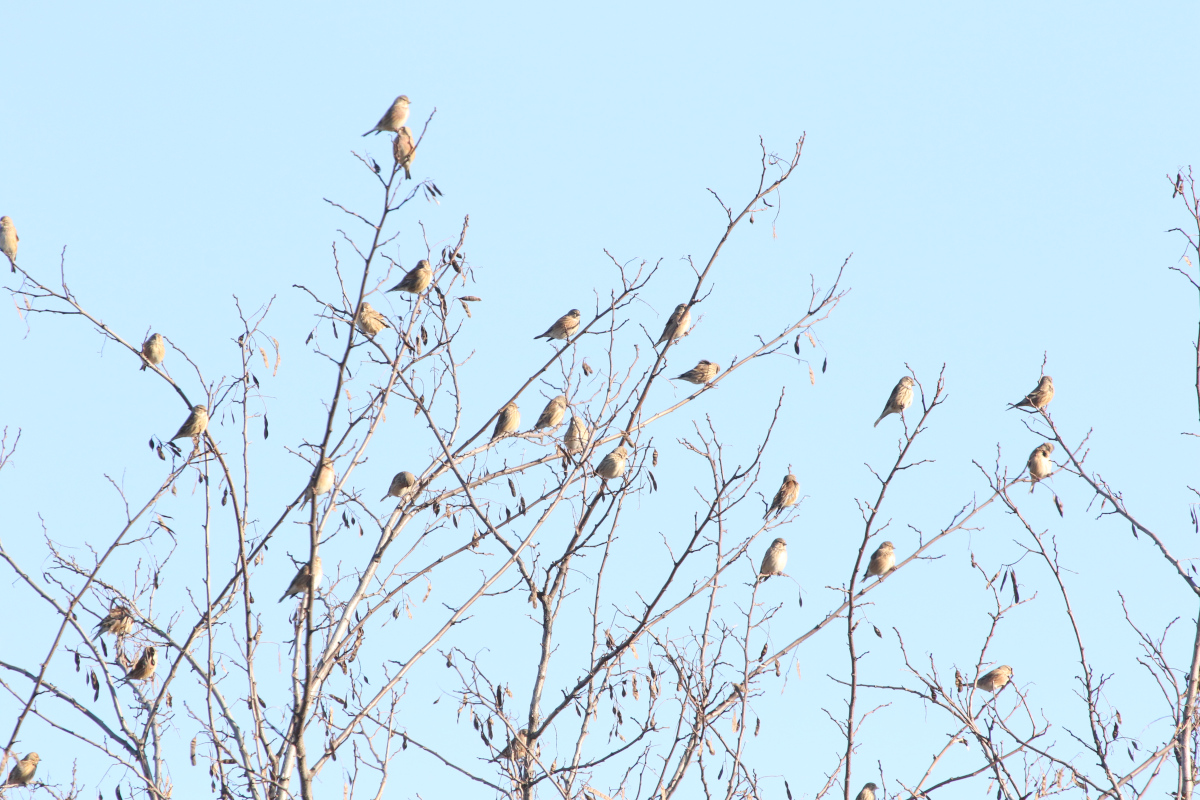
Common LinnetLinaria cannabina
European GoldfinchCarduelis carduelis
Eurasian SiskinSpinus spinus

The Bramblings and Bullfinches are two of our most anticipated winter visitors; Linnets are far less predictable, but I met several flocks:

A bare tree decorated with linnets

Buntings

Corn BuntingEmberiza calandra
Common Reed BuntingEmberiza schoeniclus

The missing

No yellowhammers, stock doves, or lesser spotted woodpeckers this time — LSW are unpredictable, but I expected the first two at least. I saw the Great Northern Diver in November this year, but not this month, and some other divers have been around that I missed completely.

So if I count again next year, I can still do a bit better, though I might change to a month with more favourable lighting conditions….

Posted in Cottbus, Nature | Comments Off on Cottbus Bird Census IV

Reading List November 2025

I finished nine books this month, four for my extended SFF/POC theme, eight by women or POC, a modest two in German, and one in Portuguese.

  • The Rosewater Insurrection — Tade Thompson
  • O último ancestral — Ale Santos
  • The Seekers — Gautamiputra Kamble, tr. Sirus J. Libeiro
  • The River Has Roots — Amal El-Mohtar
  • The Collected Stories — Grace Paley
  • Im Herzen der Katze — Jina Khayyer
  • Die Holländerinnen — Dorothee Elmiger
  • The Wind Whistling in the Cranes — Lidia Jorge, tr. Margaret Jull Costa and Annie McDermott
  • Bleak House — Charles Dickens
Cover of The River Has Roots, by Amal El-Mohtar

The Rosewater Insurrection is the second in a trilogy, and I read the first so long ago that my memory was extremely hazy, but the story was distinct enough that it wasn’t a problem. Things got very strange very quickly, the individual oddities nicely complementing the gradually emerging backstory. My only real quibble is that as in the first book (one thing I do remember) the sexual politics was sometimes questionable; I likstened to the audiobook, which had well-distinguished, if sometimes exaggerated voices and accents.

The Seekers is a short, and very distinctive collection of stories in the Ambedkarite tradition, so Buddhist and anti-caste elements are prominent. Again slightly suspect gender politics (the stories generally feature a rather submissive woman following and learning from a man), but very much redeemed by the fairytale atmosphere (as the helpful introduction points out, influenced by Buddhist jataka stories).

Fairytale is also the dominant mode in The River Has Roots, a novella (with attached short story which I think is even better). Much more politically sound, with gender-fluid fairies, there’s a satisfying story in few pages, along with some lovely details in the writing.

The last of the SFF/POC books is O último ancestral, which combines SF and fantasy elements in a way that reminded me of C. T. Rwizi. This isn’t quite as good (there’s a lot of pseudo-spiritual verbiage, and irritating tropes such as battle scenes where the antagonists intersperse their blows with declamatory conversation), and I won’t be reading the rest of the series. There was just enough to keep me reading to the end, at least.

My two German books were both Deutscher Buchpreis nominees this year. I had to buy Im Herzen der Katze because of the title, but predictably actual cats were thin on the ground. It’s essential a fictional travelogue, with no real plot beyond what is necessary to convey the life of women in Iran, which it does do rather well. There’s an odd conjunction of infodumps (such as where the characters have a conversation about the literal meaning of Iranian month-names, and one feels compelled to run through all twelve), and some very effective characterisation (especially the opening video call between the narrator and her mother).

Die Holländerinnen, winner of the prize this year, would have been better read in text than as an audiobook: it takes the form of a lecture in which the the speaker narrates a South American adventure, while going off on a maze of tangential sub-stories, all tending to a general theme of alienation — all very Herzogian. Now I have some idea of what it’s about, I definitely need to relisten, and the speaker does do a good job of highlighting the structure whenever the framing story resurfaces.

Grace Paley’s The Collected Stories was a reread — I think my third time through the whole volume. Some stories I’d forgotten completely, but the texture of the writing is unmistakable. It’s a wonderful (and wonderfully odd) world to immerse myself in every few years.

The last two books were group reads of a sort. The Wind Whistling in the Cranes was the last Portuguese in Translation group book for the year; I messed up my timing completely, starting well in advance but far too slowly, and at first I found it hard to get into it. I did pick up the pace later, if not in time to finish before the discussion, and as I began to understand the central character of Milene, it all started to make more sense. I’m not sure it had to be quite so long, but it’s a very powerful read.

Lastly, Bleak House (by my token white male) was an interesting new experience for me: the pace was kept up with daily comments from Yiyun Li about the day’s chapter(s), and discussion was (without the opportunity to go really in-depth) on Substack. I think I’d read it before — I certainly started it — but much of it was a complete surprise to me. Yet more dodgy sexual politics (an accidental theme this month), and the characters are not quite the best of Dickens, but it’s full of splendid bits along the way.

The December plan is for non-fiction, mainly because I want to read Dorothy Richardson’s letters in preparation for the next Pilgrimage read-through next year….

Posted in Books | Comments Off on Reading List November 2025

Reading List October 2025

I finished a modest eight books this month, five as part of my month’s topic of POC SF/F (plans went slightly agley due to excessive employment and being distracted by the Deutscher Buchpreis longlist). Seven by women/POC altogether, three in German, none finished in Portuguese (another fairly long one on the go). Plus one standalone short story, which I won’t count.

  • Am Samstag gehen die Mädchen in den Wald und jagen Sachen in die Luft — Fiona Sironic
  • Cursed Bunny — Bora Chung, tr. Anton Hur
  • Das gute Übel — Samanta Schweblin, tr. Marianne Gareis
  • The Space Between Worlds — Micaiah Johnson
  • Die Ausweichschule — Kaleb Erdmann
  • Frankenstein in Baghdad — Ahmed Saadawi, tr. Jonathan Wright
  • Jamaica Ginger and Other Concoctions — Nalo Hopkinson
  • Bandigoat — Rakesh Khanna (ed.)
  • Red Letter Day — Winifred Burton
cover of Das gute Übel, by Samanta Schweblin. It's a Time War-like red and blue hare motif

Starting with the project books, The Space Between Worlds was one of my highlights of the year: a parallel world SF story with a twist, where the marginalised in society have acquired an unusual niche. The multiple worlds (in several senses) give Johnson space to explore political and philosophical ideas through a fascinating set of characters.

Frankenstein in Baghdad was my only other project novel. The premise is fascinating: what better place for a creature made from spare body parts than post-invasion Baghdad? The sleazy world of booze and prostitutes (not sure how realistic) which most of the characters inhabit is also eye-opening. It dragged a bit at times, when the creature seemed to be roaming around to no particular purpose, but it reached a satisfying conclusion.

There were also three collections of short stories: Jamaica Ginger and Other Concoctions contains mostly rather slight pieces in terms of plot and character, but it’s Hopkinson’s voice which is the thing. The Jamaican vernacular was lovely to immerse myself in once a day.

The second collection, Bandigoat, arrived just in time to finish on Halloween. Again mostly short pieces by writers from various parts of India, the standout for me was the concluding The Legend of Rani Grace, which combines a satisfying plot, sweet characters, and a tremendous fairytale mythic power.

The third, Cursed Bunny is a belter. On the body/folk horror/SF spectrum, these stories sometimes gave me the impression that I’d always known them, which I take as a good sign, but they’re also rooted in Chung’s own very sound politics.

I don’t count Red Letter Day as a book, because it’s a standalone story (and I read it in the early hours of All Saints’ Day), but it deserves a brief mention: silly but fun, it’s worth 20 minutes of your time. Also, the Asasabonsam family helped me to understand the villainous Asanbosam in O último ancestral, a Brazilian SF/F book which I didn’t manage to finish in time).

Then the three books in German: Das gute Übel is by Samanta Schweblin and therefore a guaranteed banger. The often longish short stories give room for the plots and characters to develop, especially in the wonderful Das Auge in der Kehle (seemingly a riff on Carver’s A Small, Good Thing).

Finally, I read two of the Deutscher Buchpreis shortlist (the winner, Die Holländerinnen, hopefully this coming month): Am Samstag gehen die Mädchen in den Wald und jagen Sachen in die Luft has of course an outstanding title, and the rest of the book is pretty good. It’s in a near-future, climate-fiction mildly dystopian setting, but it’s real issue is with the social dystopia which we’re already in the middle off. One nice super-Bechdel feature: all the characters just happen to be women, and the only romantic relationships are lesbian.

I liked Die Ausweichschule even more: an autofictional novel about a young author trying to write about a school shooting he experienced as a child, there’s a lot of humane humour in the book, especially in the Setzian dialogue.

Next month looks a bit messy, but should be mainly a mix of more POC/SFF and O Canada (there being a two-book overlap between the two). I’m also spending quite a lot of reading time on the APS group read of Bleak House, so we’ll see what happens.

Posted in Books | Comments Off on Reading List October 2025

Reading List September 2025

I finished 11 books in September, 8 by women/POC, seven of those for my Black writers monthly topic, with three in German and one in Portuguese.

  • Zwei Herren am Strand — Michael Köhlmeier
  • Jubel und Schmerz der Mandelkrähe — Jurij Koch
  • One Boat — Jonathan Buckley
  • Whites Can Dance Too — Kalaf Epalanga, tr. Daniel Hahn
  • Roots — Alex Haley
  • Black — Tobias Taitt and Anthony Smith
  • Requiem Moon — C. T. Rwizi
  • I Heard What You Said — Jeffrey Boakye
  • Não fossem as sílabas do sábado — Mariana Salomão Carrara
  • Grenzenlos und unverschämt — May Ayim
  • Captive: New Short Fiction from Africa — Rachel Zadok and Helen Moffett (ed.)
Covers of Black, Grenzenlos und unverschämt, and Jubel und Schmerz der Mandelkrähe.

One of the main reasons for the choice of topic was (as usual) the Portuguese in Translation novel for this month, Whites Can Dance Too. It’s highly educational for those such as myself who are ignorant of Angolan dance music, specifically kuduro; the book and youtube have made me less ignorant, even if it’s not quite my thing (but I recommend watching e.g. The Sound of Kuduro by Epalanga’s group, Buraka Som Sistema — it sounds like the end of the world). I did have some reservations about the novel, especially the stilted dialog (often info-dumping), and the sexualisation of the female Norwegian police officers.

While on Lusophone books, I’ll pause to mention Não fossem as sílabas do sábado, which was my Portuguese re-read. It’s an absolutely stunning book, from the opening scene to the ending which I’d forgotten, but which is an excellent conclusion to a novel which takes place almost entirely in the narrator’s flat. Carrara’s long sentences are brilliantly structured, and the audiobook (read by her) is perfectly suited to bring out their emotional power. Up among the best books I’ve read in any language.

Back to Black writers, and Roots took up an interestingly central role in my reading: not just because I spent a lot of time listening to it, but also because it was namechecked in two other books I read, showing its influence in 80s Black British culture. It is much too long — I found the African section the most interesting as the least familiar, though the American part is also interesting on the relations and accommodations made between slaves and slave-owners. The second half rambles a lot, but despite the flaws this is a big book in every sense.

The first of those namechecking books was Black, an autobiographical graphic novel. This being the 70s and 80s, there’s a lot of darkness around, illustrating the point several of the month’s authors make about the assiciation of blackness with negativity in European/Anglo-Saxon culture. Visually, Smith takes the opportunity to show the Black skin and literal and moral darkness of the environment in a thought-provoking way:

A panel from Black, showing the darkness of the protagonist's environment.

The second, and another audiobook read by the author, was I Heard What You Said. It’s an interesting counterpoint: Boakye grew up in a similar period to Taitt, but in a much more nurturing environment, and spends most of the book discussing his experiences as an English teacher in British schools. It’s another book that could have been a bit shorter — it gets repetitive towards the end — but Boakye is engaging and especially interesting for fellow teachers.

I started Requiem Moon some time ago, and it was initially confusing to get back into, with a big cast, and lots of political intrigue. But as with the first book in the series, the African-SF-fantasy setting was interesting enough to recapture my attention, and the latter part of the book in particular is a rollicking rollercoaster. I’ll be reading part 3, ideally in one go.

My short stories this month were Captive: New Short Fiction from Africa: not all Black authors, but I think enough to count. Only two duds, which is good going, and some — e.g. Wednesday’s Delight, and The Girl with Three Faces — were very good. As the subtitle mildly hints, not all of the pieces are really short stories, some reading more like excerpts from novels, but with expectations suitably adjusted this was a nicely-varied collection.

Finally for Black authors, Grenzenlos und unverschämt is a collection of various non-fiction pieces by May Ayim, covering some of the same ground as each other and her other texts. It would be a good introduction to her non-fiction work, and I found the account of her studies to be a speech-therapist particularly engaging. One incidental positive is being reminded how bad racism was in Germany in e.g. the early 90s, which puts the current horrors into some perspective.

Two other German books: I read Zwei Herren am Strand because Köhlmeier was longlisted for the Deutscher Buchpreis, though he didn’t make the shortlist. This is one of his earlier books, based on the real-life relationship between Charlie Chaplin and Winston Churchill, but firmly transmuted into fiction. I had to keep interrupting my reading to check whether particular details were real or not, which I think is a sign that I was sufficiently involved. The scene with Hitler and Churchill meeting in the toilets is excellent!

Jubel und Schmerz der Mandelkrähe was interesting not just because it’s an account of places which I (mostly) know; it’s also interestingly-written, with poetic flights on top of the factual basis. It’s not cheerful — both Mandelkrähe and the humans have more Schmerz than Jubel — but even the descriptions of what has been lost contribute to preservation.

Finally, One Boat was interestingly subtle — I kept waiting for something dramatic to happen, but it’s more an opportunity to think about memory and reality — hoary topics, but deftly handled. It’s one which I’d like to read again, now that I know how to read it.

On to next month, which is SF/F by POC, mostly because I had some which I didn’t manage to fit into this month. Since choosing the theme, I’ve discovered that October is also Black Speculative Fiction Month, and I’d like to tie it into the British Black History Month too.

Posted in Books | Comments Off on Reading List September 2025