I finished 11 books in September, 8 by women/POC, seven of those for my Black writers monthly topic, with three in German and one in Portuguese.
- Zwei Herren am Strand — Michael Köhlmeier
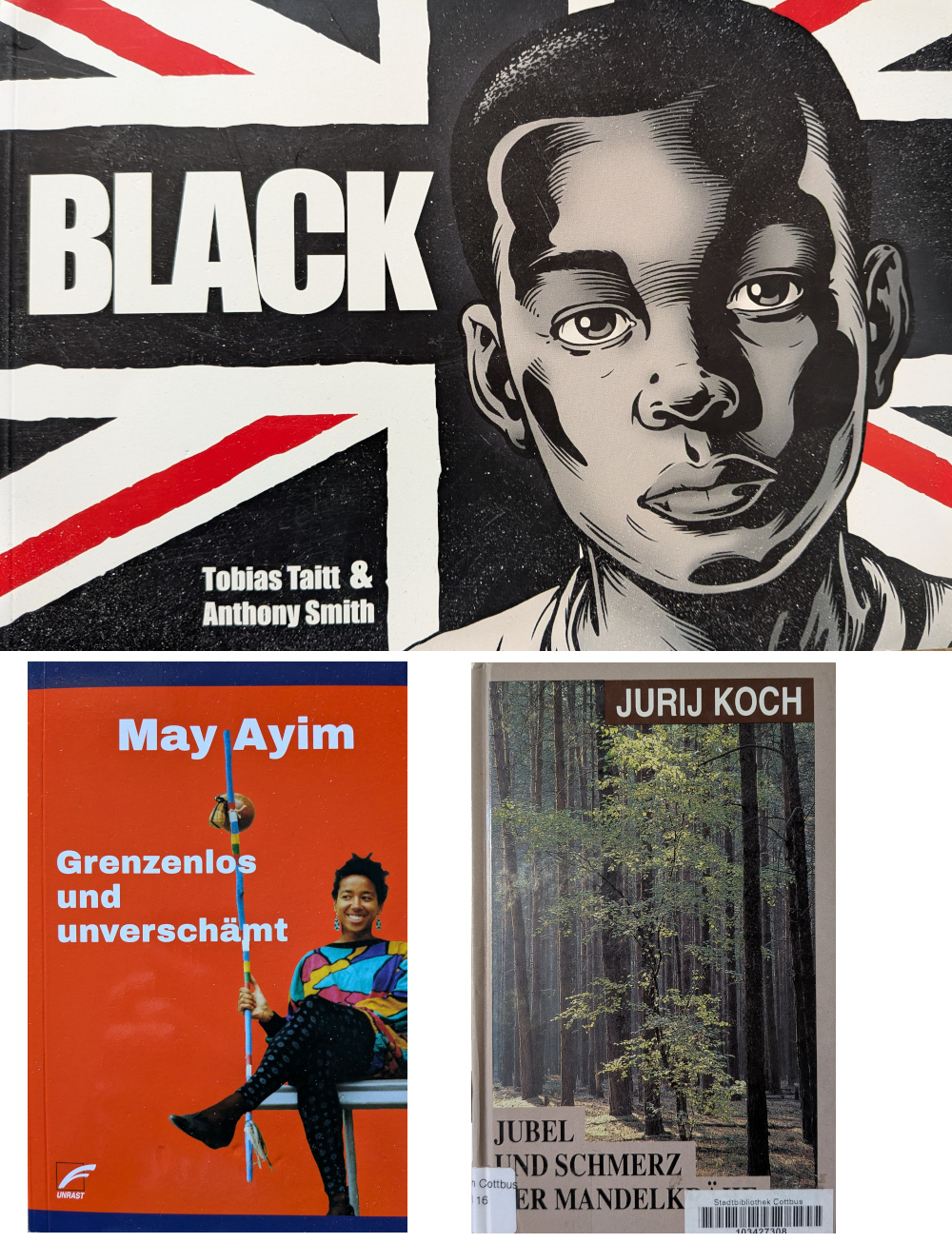
- Jubel und Schmerz der Mandelkrähe — Jurij Koch
- One Boat — Jonathan Buckley
- Whites Can Dance Too — Kalaf Epalanga, tr. Daniel Hahn
- Roots — Alex Haley
- Black — Tobias Taitt and Anthony Smith
- Requiem Moon — C. T. Rwizi
- I Heard What You Said — Jeffrey Boakye
- Não fossem as sílabas do sábado — Mariana Salomão Carrara
- Grenzenlos und unverschämt — May Ayim
- Captive: New Short Fiction from Africa — Rachel Zadok and Helen Moffett (ed.)
One of the main reasons for the choice of topic was (as usual) the Portuguese in Translation novel for this month, Whites Can Dance Too. It’s highly educational for those such as myself who are ignorant of Angolan dance music, specifically kuduro; the book and youtube have made me less ignorant, even if it’s not quite my thing (but I recommend watching e.g. The Sound of Kuduro by Epalanga’s group, Buraka Som Sistema — it sounds like the end of the world). I did have some reservations about the novel, especially the stilted dialog (often info-dumping), and the sexualisation of the female Norwegian police officers.
While on Lusophone books, I’ll pause to mention Não fossem as sílabas do sábado, which was my Portuguese re-read. It’s an absolutely stunning book, from the opening scene to the ending which I’d forgotten, but which is an excellent conclusion to a novel which takes place almost entirely in the narrator’s flat. Carrara’s long sentences are brilliantly structured, and the audiobook (read by her) is perfectly suited to bring out their emotional power. Up among the best books I’ve read in any language.
Back to Black writers, and Roots took up an interestingly central role in my reading: not just because I spent a lot of time listening to it, but also because it was namechecked in two other books I read, showing its influence in 80s Black British culture. It is much too long — I found the African section the most interesting as the least familiar, though the American part is also interesting on the relations and accommodations made between slaves and slave-owners. The second half rambles a lot, but despite the flaws this is a big book in every sense.
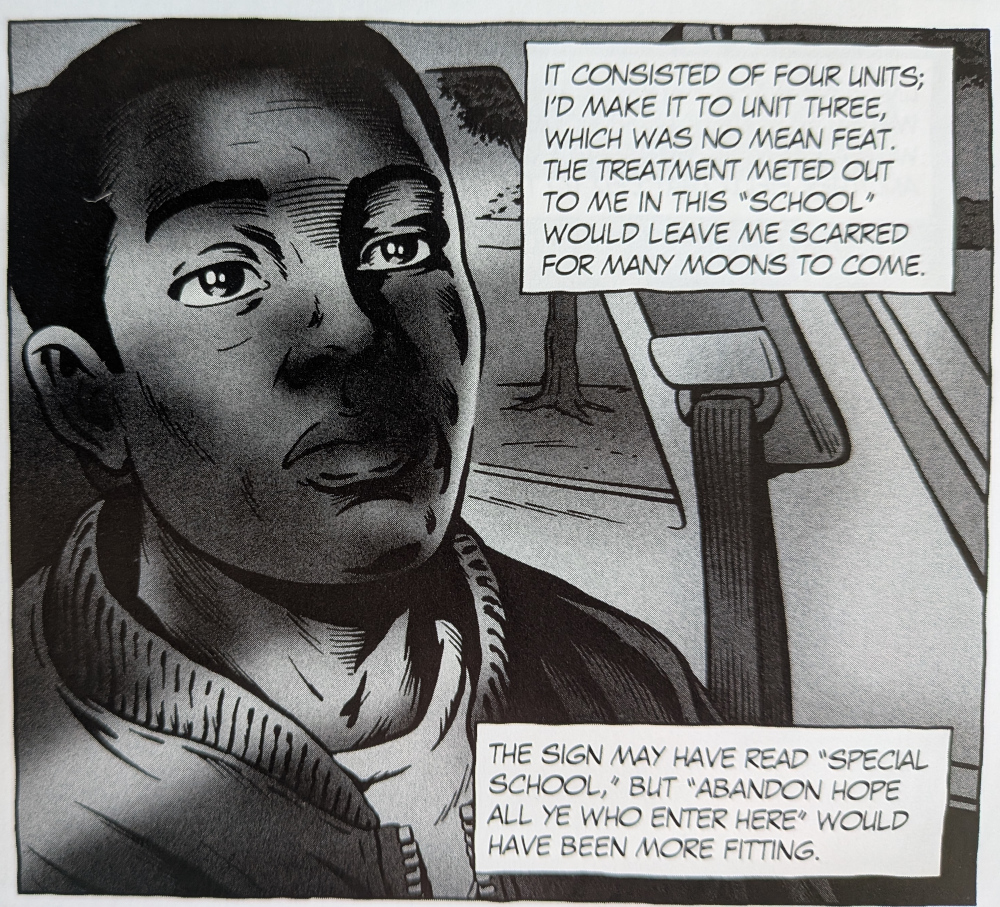
The first of those namechecking books was Black, an autobiographical graphic novel. This being the 70s and 80s, there’s a lot of darkness around, illustrating the point several of the month’s authors make about the assiciation of blackness with negativity in European/Anglo-Saxon culture. Visually, Smith takes the opportunity to show the Black skin and literal and moral darkness of the environment in a thought-provoking way:
The second, and another audiobook read by the author, was I Heard What You Said. It’s an interesting counterpoint: Boakye grew up in a similar period to Taitt, but in a much more nurturing environment, and spends most of the book discussing his experiences as an English teacher in British schools. It’s another book that could have been a bit shorter — it gets repetitive towards the end — but Boakye is engaging and especially interesting for fellow teachers.
I started Requiem Moon some time ago, and it was initially confusing to get back into, with a big cast, and lots of political intrigue. But as with the first book in the series, the African-SF-fantasy setting was interesting enough to recapture my attention, and the latter part of the book in particular is a rollicking rollercoaster. I’ll be reading part 3, ideally in one go.
My short stories this month were Captive: New Short Fiction from Africa: not all Black authors, but I think enough to count. Only two duds, which is good going, and some — e.g. Wednesday’s Delight, and The Girl with Three Faces — were very good. As the subtitle mildly hints, not all of the pieces are really short stories, some reading more like excerpts from novels, but with expectations suitably adjusted this was a nicely-varied collection.
Finally for Black authors, Grenzenlos und unverschämt is a collection of various non-fiction pieces by May Ayim, covering some of the same ground as each other and her other texts. It would be a good introduction to her non-fiction work, and I found the account of her studies to be a speech-therapist particularly engaging. One incidental positive is being reminded how bad racism was in Germany in e.g. the early 90s, which puts the current horrors into some perspective.
Two other German books: I read Zwei Herren am Strand because Köhlmeier was longlisted for the Deutscher Buchpreis, though he didn’t make the shortlist. This is one of his earlier books, based on the real-life relationship between Charlie Chaplin and Winston Churchill, but firmly transmuted into fiction. I had to keep interrupting my reading to check whether particular details were real or not, which I think is a sign that I was sufficiently involved. The scene with Hitler and Churchill meeting in the toilets is excellent!
Jubel und Schmerz der Mandelkrähe was interesting not just because it’s an account of places which I (mostly) know; it’s also interestingly-written, with poetic flights on top of the factual basis. It’s not cheerful — both Mandelkrähe and the humans have more Schmerz than Jubel — but even the descriptions of what has been lost contribute to preservation.
Finally, One Boat was interestingly subtle — I kept waiting for something dramatic to happen, but it’s more an opportunity to think about memory and reality — hoary topics, but deftly handled. It’s one which I’d like to read again, now that I know how to read it.
On to next month, which is SF/F by POC, mostly because I had some which I didn’t manage to fit into this month. Since choosing the theme, I’ve discovered that October is also Black Speculative Fiction Month, and I’d like to tie it into the British Black History Month too.