A modest end to the year, with 8 books finished, 6 for my non-fiction monthly theme, and 6 also by women/POC (in this case, all just women!), 1 in Portuguese and a dismal 1 in German.
- Greyhound — Joanna Pocock
- Irgendwo — Agota Kristof, tr. Carina von Enzenberg
- Ancestors — Alice Roberts
- Erik Satie Three Piece Suite — Ian Penman
- Bird Therapy — Joe Harkness
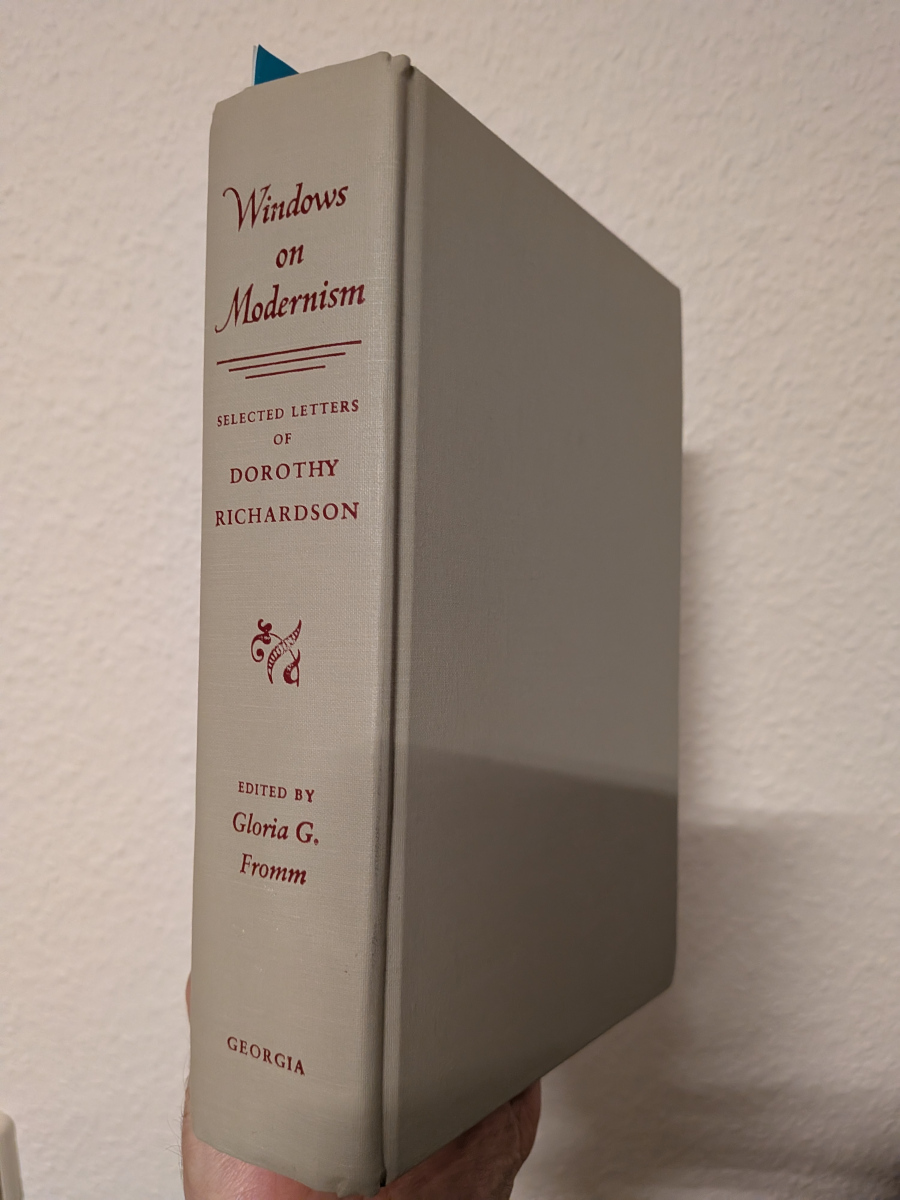
- Windows on Modernism — Gloria G. Fromm (ed.)
- A árvore mais sozinha do mundo — Maria Salomão Carrara
- Shadow Behind the Sun — Remzije Sherifi
Windows on Modernism — letters by Dorothy Richardson — was the reason for the theme, and the reason why I didn’t get much other reading done (almost 700 pages). This was mainly preparation for next year’s Pilgrimagathon, and after a slow start getting to know her correspondents, I found it equally useful and enjoyable. Following the progress (or not) of Pilgrimage‘s production is fascinating, and I’ve acquired a list of writers in her circle that I want to start on next month. The experience of reading the letters is a nice parallel to Pilgrimage itself, seeing the world through the eyes of one woman! Still thinking about Henry James’s waggling backside:
To-day, meaning roughly your & my days, so many, in fact most, writers have been so consciously & laboriously literary, that in reading them- & the reading may be joy-one is so fascinated by what they are doing, technically, by tracing exactly how they get their effects, that one is tempted to paraphrase Emerson’s “What you are speaks so loudly that I cannot hear what you say” into “What you so cunningly, & successfully, are doing is so impressive, interesting, tiresome, tedious, stultifying, that meaning, what you are saying, or trying to say, is secondary.” And sometimes to add “You have really nothing to say, or are keeping back what, if anything, you want to say, in the interest of a cunning way of saying it.” This I feel most strongly in regard to Henry James; for whom Europe was too much. His style, fascinating at a first meeting for me can only be, very vulgarly, described as a non-stop waggling of the backside as he hands out, on a salver, sentence after sentence, that yes, if the words had no meaning, would weave its own spell. So what? one feels, reaching the end of the drama in a resounding box, where no star shines & no bird sings.
I also took the opportunity to read two of Fitzcarraldo’s white-jacketed non-fiction books: Greyhound is an account of three overlaid journeys from Canada to Las Vegas and California on Greyhound buses: one by Pocock post-Covid, with recollections of her earlier trip on the same route while writing a novel whose protagonist follows the same path. Pocock’s good on the suburbs:
Suburbs are environmental cosplay for folk who want to imagine themselves as farmers (those flower beds!), landowners (those decorative architectural and lawn ornaments!) or even hunter-gatherers (those steaks on the barbecue!)
but the overwhelming impression is of the squalor into which many of the places, and the buses, have descended in the interim, though some things do happen towards the end to lighten the mood.
The second Fitzcarraldo was Erik Satie Three Piece Suite, a desk-based exploration of the life and work of Satie. It’s mostly fragmentary, with an alphabetical list of people and topics followed by Penman’s diary of the project, which is a very Satiesque way of doing things. There’s a little more whimsy than I’d like (especially the dreams in the diary section), but it sent me back to the music, which is a win.
Ancestors was an audiobook which I bought dutifully some time ago and never got round to, but it turned out to be much more interesting than I’d thought. Roberts takes a series of burials (or possibly not — that’s one of her main topics) as the starting point for a wider discussion of archaeology and genetic science.
Shadow Behind the Sun is an account of the years leading up to Kosova’s independence, with a focus on Serbian atrocities and the author’s escape to, eventually, Glasgow (which partly explains the publisher residing in Dingwall). The short chapters on the burgeoning support network in Scotland are heartwarming, while the fact that similar events to today were taking place 20 years ago gives some important perspective.
The last non-fiction book, Bird Therapy, wasn’t such a success: the therapy side involved too much statement of the obvious for me, while the bird side was dominated by breathless accounts of the author’s bird-watching trips which lose something in the re-telling.
The short-stories this month were Agota Kristof’s Irgendwo, a collection of often very short texts which was mostly excellent. They share with her longer works the satirical fairytale darkness, with only a few seeming too abstract for my taste.
FInally, A árvore mais sozinha do mundo is, like all Maria Salomão Carrara’s books, very different from her others! Narrated by a tree and various household objects, it’s a story of the (mostly) woes of life as a tobacco farmer in the south of Brazil, though the unusual narrators add a well-judged element of distancing and irony. Still nowhere near as good as Não fossem as sílabas do sábado, however.
Next month will be focused on early 20th-century mostly modernists, in tribute to the beginning of the Richardson read-through….