
I finished 12(ish) books this month, 11 by women/POC, and 10 of those for #WITMonth. 5 in German, and one in Portuguese.
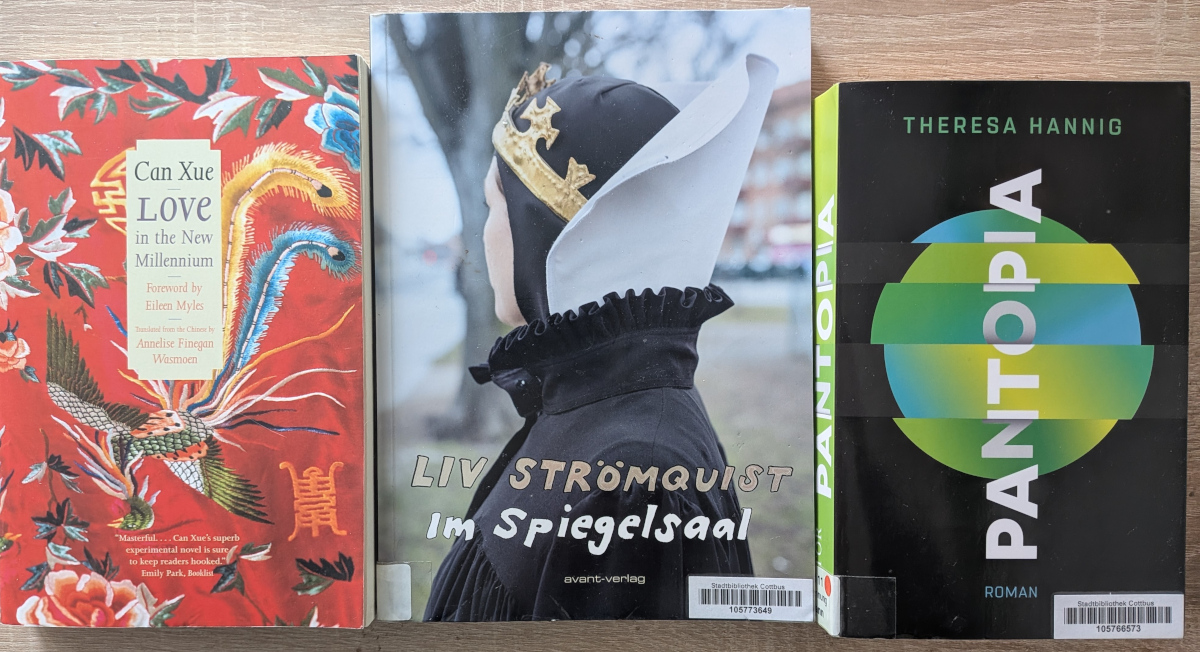
- The Book of Disappearance — Ibtisam Azem, tr. Sinan Antoon
- Nachdenken über Christa T. — Christa Wolf
- Pantopia — Theresa Hannig
- Das große Heft — Ágota Kristóf, tr. Eva Moldenhauer
- Heart Lamp — Banu Mushtaq, tr. Deepa Bhasthi
- Portalpettai — Avakkai and Chukka
- Im Spiegelsaal — Liv Strömquist, tr. Katharina Erben
- Child of All Nations — Irmgard Keun, tr. Michael Hofmann
- Besuch bei Zerberus — Anne Weber
- Love in the New Millennium — Can Xue, tr. Annelise Finegan Wasmoen
- A Sunny Place for Shady People — Mariana Enriquez, tr. Megan McDowell
- Jesusalém — Mia Couto
Starting with the women in translation (per the “rules”, not all actually in translation, but not originally written in English): The Book of Disappearance, first published in 2014, anticipates the current (phase of the) genocide, so could hardly be more politically relevant. As a novel I found it slightly disappointing though: Azem is sometimes excellent at conveying the Israeli as well as the Palestinian perspectives, but the central Israeli character was for me totally unconvincing, which is quite a problem.
Heart Lamp is another book partly overshadowed by its politics: this is an India of institutional cruelty to women in particular, as well as other people and animals. As literature, the much-noted Kannada flavour to the language is enjoyable, while the stories themselves are variable: the elements of the fantastic in e.g. High-Heeled Shoe were highlights for me.
(Parenthetically, Portalpettai was written in English, so not technically eligible, as well as being tiny in word count, but it’s an interesting pendant to Heart Lamp re: South Indian women. It’s a very whimsical Area X, not even really a story, but a fun few minutes. The epub was illegible on my computer and minuscule on my ereader, so getting the pdf for a computer would probably be wisest.)
Nachdenken über Christa T. is short but knotty. It’s reminiscent of her later Kindheitsmuster in its gradual archaeology of a life, but in this case of the narrator’s friend rather than herself. I think Kindheitsmuster is better, but this is still a fine book. The fluidity with which Wolf slips between different times and reflections on them can be demanding to follow, so I read the text after listening to the audiobook, and got a lot out of both.
Pantopia was a fun, easy read, combining Utopian politics with AI that does more than generate slop. One could quibble with specific plot points in both areas, but it’s entertaining and thought-provoking, which is a pretty good combination.
Das große Heft was fantastic — entertaining and disturbing in best fairytale fashion, but in the modern(ish) world. It reminded me in that respect of another semi-French writer, Anne Weber, which is a recommendation in itself.
That prompted me to read Besuch bei Zerberus — quite early Weber, and really one for the hard-core Weberians (such as me). It’s a very slippery meditation on the border of life and death (later explored more extensively in her phenomenal Tal der Herrlichkeiten), set against the writer’s relationship with her father (which makes more sense if you’ve read Ahnen). Read all those first, then maybe come back to this one!
Also nicely related to Das große Heft, Child of All Nations is again the Nazi period seen through the eyes of a child, in this case the daughter of a Roth-Mann-style refugee. The darkness and innocence are interestingly balanced; the whimsy can occasionally be overpowering, but the moments that ring true are very good. Here, for example, she starts brilliantly, then makes it too neat for me:
I saw some wonderful flower shops, and some of the flowers looked almost like lilacs – maybe they were lilacs. Unfortunately I couldn’t smell them through the plate-glass windows. But women walked past me with wafts of scent, and I quickly did some magic: I looked at all the lilac-like flowers in the shop window and at the same time I smelled what the women wafted at me – and suddenly I had lilac and May and my mother. I kissed the window, and so I kissed her.
Im Spiegelsaal, a non-fiction “graphic novel” (graphic essay, perhaps) is classic Liv Strömquist: a feminist discussion of beauty and celebrity in modern society, with lots of good jokes translated into wonderfully slangy German:
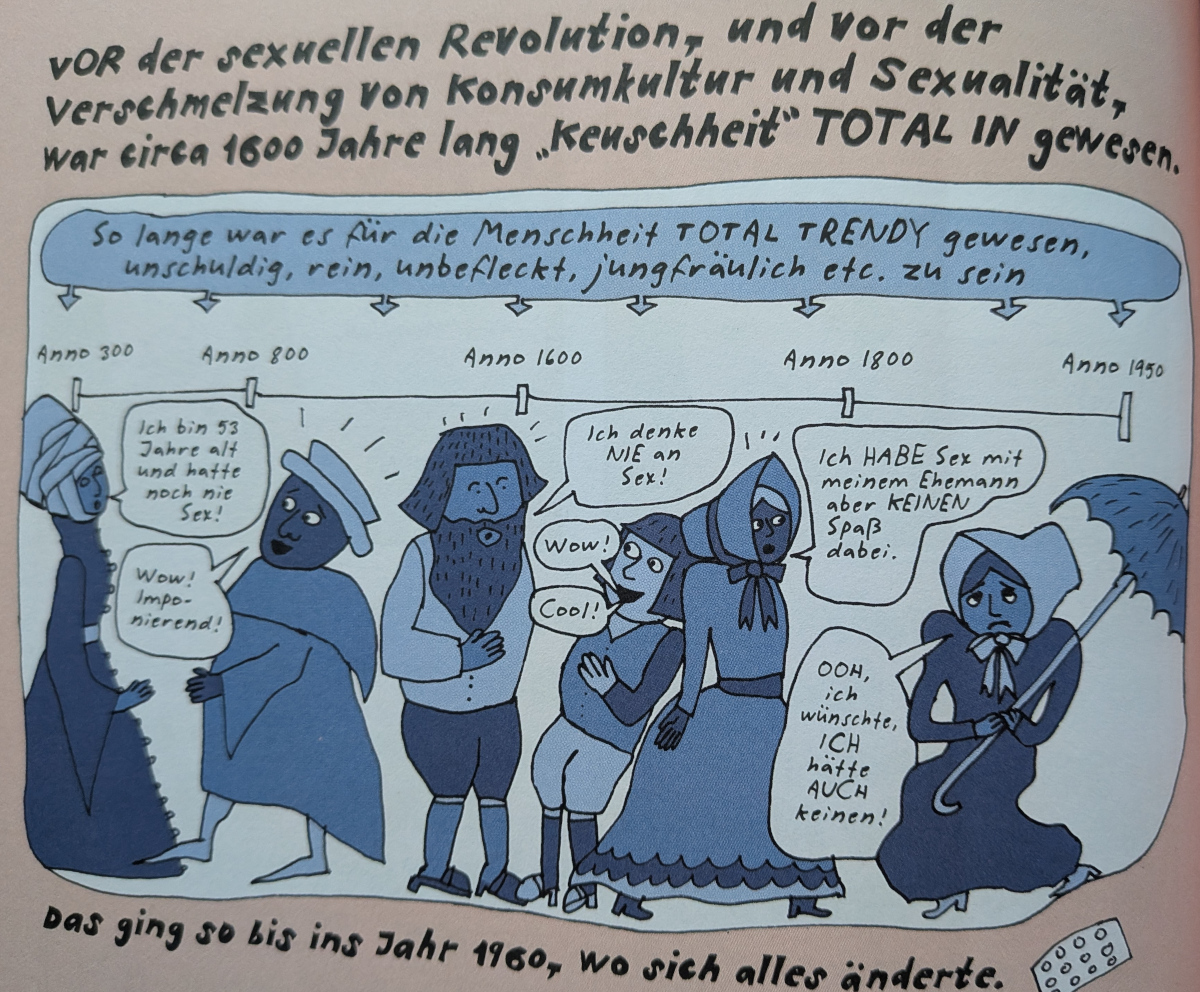
There’s a lot of text, but even that’s wittily handled:

Love in the New Millennium was my latest attempt at Can Xue. I didn’t hate every moment of it — the Nest County chapters were relatively calm — but novel length dream sequences are not for me. I’m done with her for a while, I think, having dutifully waded through a novel and a story collection.
Finally, A Sunny Place for Shady People is an instructive contrast with the Can Xue: normally horror is some distance from my bag, but in most of these stories Enriquez limits the weirdness to one irruption, then traces the consequences for the otherwise realistic story very effectively. A great finish for the month.
My only writer with testicles was Mia Couto: Jesusalém was a toughie, which is why it took me almost two months to finish. He is another of those authors who gives me a much-needed sense of perspective on the size of my Portuguese vocabulary, while there was one chapter in particular that was at first so lacking in context that I could only plod through a few pages at a time. Things picked up again though, and I enjoyed the blend of the bizarre and the familiar from my own time in Mozambique. The sexual politics is sometimes disturbing, though that could be attributed to the realities of the setting rather than the author.
I’ve declared September Black month, for no particular reason. I’ve already started a couple of chunky books, and my provisional list is getting longer by the day….