I finished ten books this month, six for my slightly patronising topic of “sound Americans”, five by women/POC, three in German, with one graphic novel. No Portuguese, because I’m working through a big one. 🙂
- Understanding Literature and Life: Drama, Poetry and Narrative — Arnold Weinstein
- Liberation Day — George Saunders
- The Music of Chance — Paul Auster
- Als lebten wir in einem barmherzigen Land: — A. L. Kennedy, tr. Ingo Herzke and Susanne Höbel
- Starter Villain — John Scalzi
- City of God — Paolo Lins, tr. Alison Entrekin
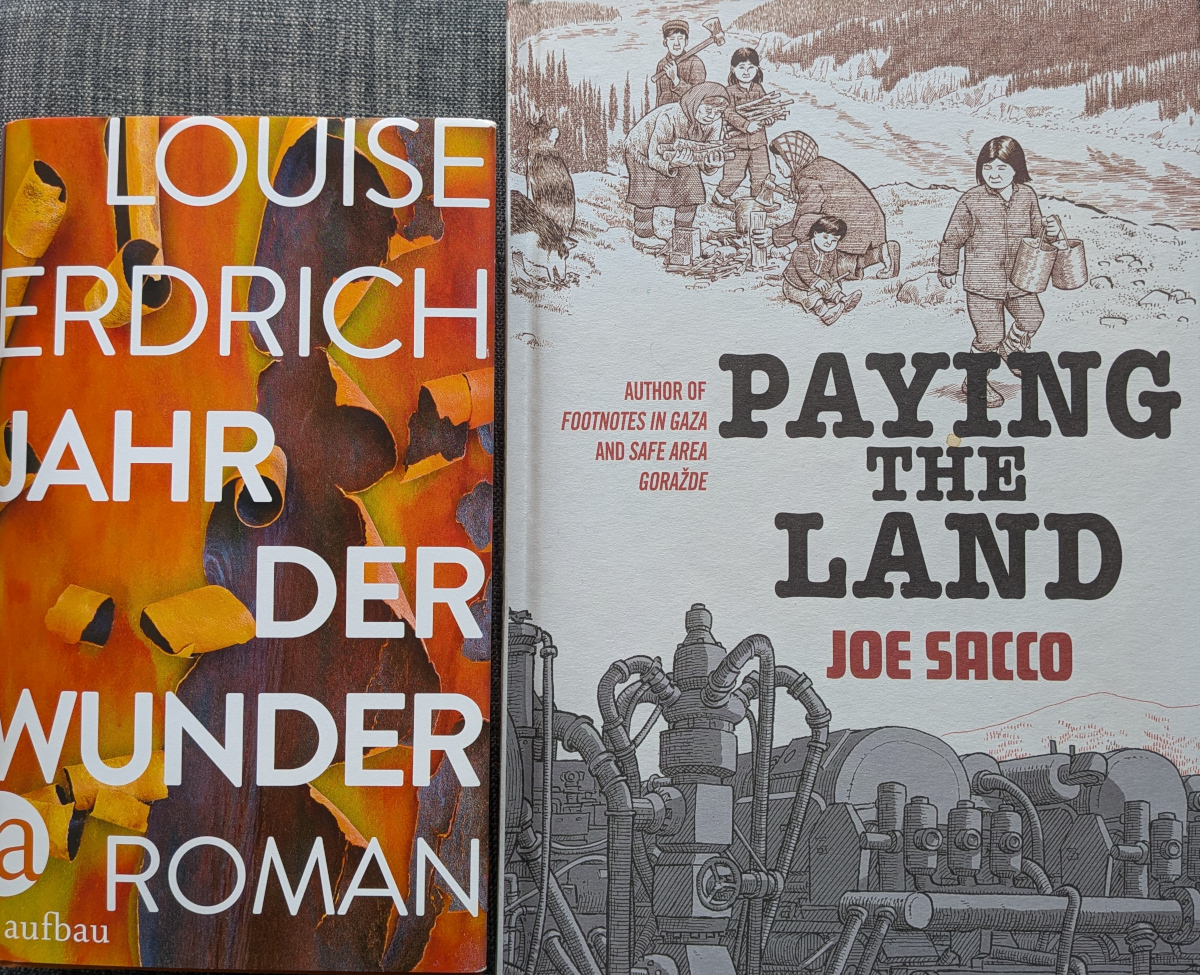
- Paying the Land — Joe Sacco
- Jahr der Wunder — Louise Erdrich, tr. Gesine Schröder
- Weisse Wolken — Yandé Seck
- Men Explain Things to Me — Rebecca Solnit
Understanding Literature and Life: Drama, Poetry and Narrative is sort of a book — a collection of lectures distributed as an audiobook, and I spent 30 hours listening to it, so I’m counting it. (I haven’t included it in my good Americans total because I don’t know enough about Weinstein’s politics). His analyses of the various works are always interesting, whether or not I’d already read them, and he’s spurred me to seek out some of those that were less familiar (especially the poetry). There’s an odd lack of novels, but since that’s already the field I know best, I’ve no objection to that.
The first project book, Liberation Day was classic George Saunders: stories which are initially often mystifying, but soon enough make a sense which combines satire and warm-heartedness to great effect. The title story was a particularly highlight, and the audiobook as a whole had excellent performances.
The Music of Chance was also typical Auster, other than having relatively little connection with New York. Road trips, chance (obviously), and a descent into absurdity are all present. The wall at the centre of the story is a perfect symbol of so many things that one can understand the protagonist’s growing obsession with it.
Starter Villain was the first actual novel I’d read by John Scalzi, though I’ve followed him partly for political reasons on social media for years. It’s a great romp, with lots of double dealing, and enjoyable characters (not all human). Now I need to read some of his real science fiction!
Men Explain Things to Me is another book I felt I already knew through social and other media, but it was good to go back to where mansplaining started (as it were). Solnit is sometimes a little too fixated on Solnit, but the essays collected here are always a pleasure to read and, importantly these days, reasonably hopeful.
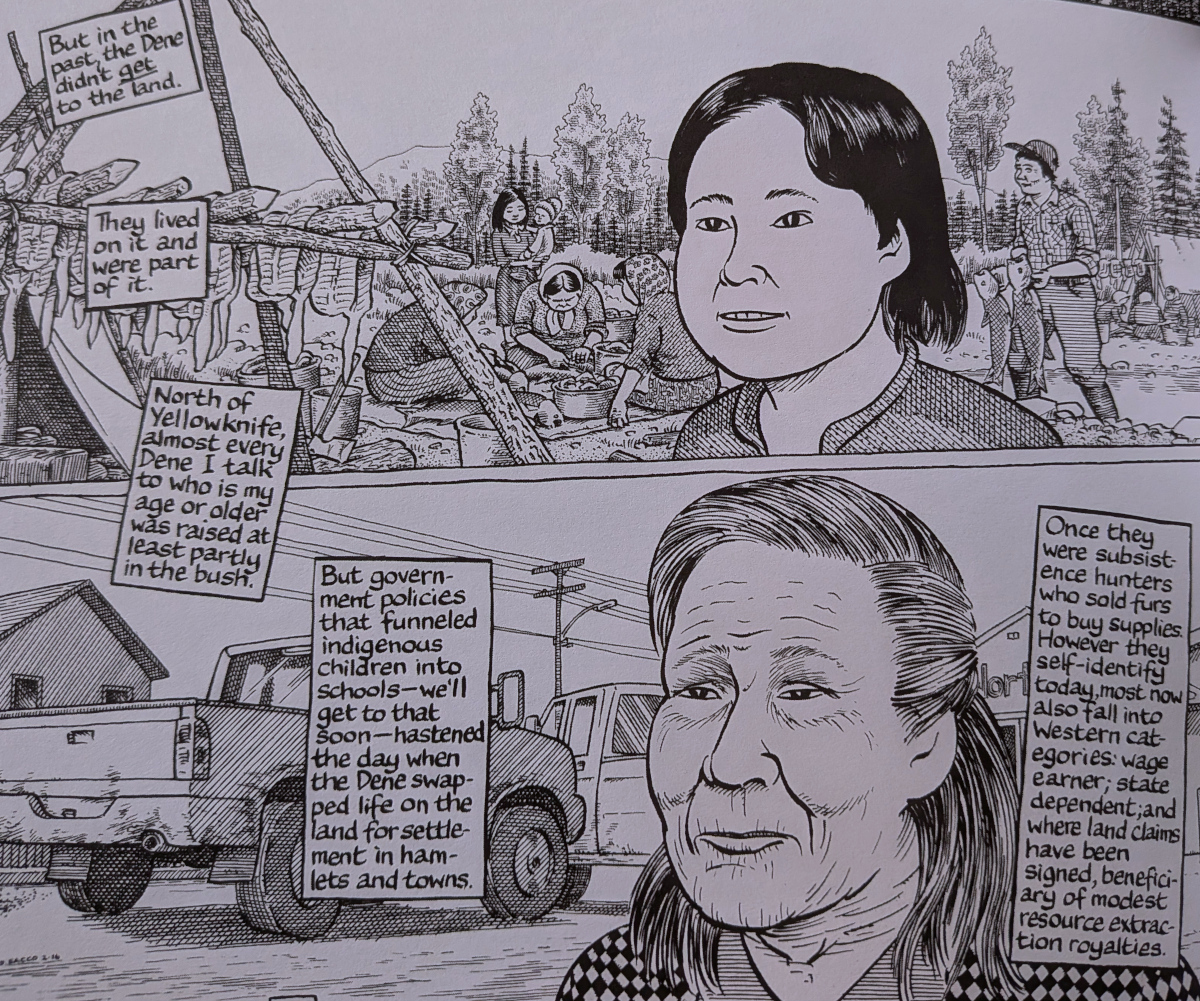
My last two project books coincidentally deal with native American societies: Paying the Land is a graphic novel about Sacco’s trip to Canada’s Northwest Territories, and is accessibly enlightening on the different groups and their approaches to reconciling their traditions with the modern (or western/Anglo, or perhaps something else) world. Sacco’s interviewees come across as rounded characters, showing the power of the format he uses:
I read Jahr der Wunder (The Sentence in English) in translation because I happened to have it, and found it fascinating — again, particularly regarding the lives of modern native Americans, this time in Minnesota. The central ghost story is overlaid with the current events of 2020 (Covid, of course, and I hadn’t registered that the murder of George Floyd took place there and then). The combination of the two made me feel a bit queasy — whether trivialising the real events or giving undue weight to the ghost story — but putting that aside, the charismatic characters kept me turning the pages.
Again coincidentally, Als lebten wir in einem barmherzigen Land is another “Covid novel” (though much more than that) which I read in translation. Interestingly it had two translators, each working on sections written from the point of view of a different character. Kennedy’s righteous anger over the British government’s Covid failings rather overshadows the more central plot point of the Spycops scandal and its effects on the victims, but the book is well worth reading for this aspect alone.
The third German novel, Weisse Wolken, is reminiscent in its set-up of Jackie Thomae’s Brüder, which I read some time ago: two children (here sisters) of a Senegalese father and German mother grow up in Germany, though here thanks to some murky plot-tweaking the siblings have both parents in common, and have a substantial age gap, which Seck uses to show their different generational attitudes. These sometimes seem a little exaggerated (the older sister knows rather less about racial politics than me, despite being a therapist), but the development of the characters is involving. It might have been better to read as text than as an audiobook, as I found it tricky to work out who was who at first.
Finally, City of God was the latest Portuguese in Translation discussion group book. It’s moderately long (400-odd pages, apparently edited down from about 600), but feels longer because it’s so episodic. Rather like with Roberto Bolaño’s 2666, it’s mostly a series of acts of violent depravity, which numbs the reader with repetition. Again as with 2666, that’s presumably deliberate, but it did make it slow going for me. There’s more humour in this case (rather like a Brazilian Trainspotting). The slang and local references make it difficult to translate (and the discussion with Entrekin and Lins was illuminating on this), and inevitably a lot is lost when rendering it into a generalised English.
Next month is August, and so Women in Translation month (mostly).