
I finished ten books in June: eight for my poor excuse for a monthly theme (“finishing off books I’d already started”), six by women/non-binary/POC, one in Portuguese, and a measly one in German. That makes a nice round sixty for the first half of the year.
On Earth We’re Briefly Gorgeous — Ocean Vuong
Every Short Story 1951-2012 — Alasdair Gray
The Acceptance World — Anthony Powell
Animal Joy — Nuar Alsadir
Se deus me chamar não vou — Mariana Salomão Carrara
Star Songs of an Old Primate — James Tiptree Jr.
Illuminations — Alan Moore
Lili is Crying — Hélène Bessette, tr. Kate Briggs
The Space Machine — Christopher Priest
Proxi — Aiki Mira
On Earth We’re Briefly Gorgeous was a classic example of a book to get stuck on — I enjoyed it while I was reading it, but the poetic drifiness of the style didn’t oblige me to pick it up again. The second half, which I read this month, did pick up the pace as the love story takes the central role. I recently read a review of Vuong’s new novel which incidentally skewers the weaknesses of this one quite accurately, but despite those failings (basically, being precious) there was enough here to justify finishing.
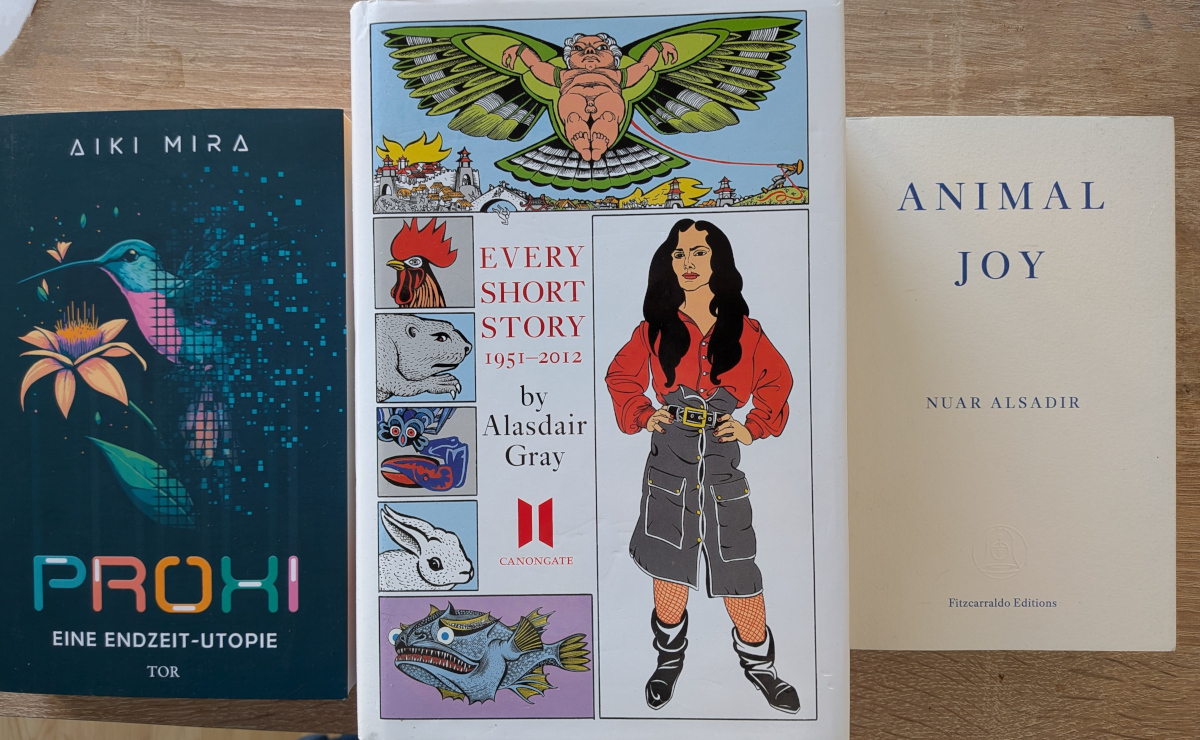
Every Short Story 1951-2012 took a while both because it’s big (900 plus pages), and by the nature of the short-story collection beast. Gray generously includes most of the novel Something Leather, as it’s composed of separate stories. It’s fair to say that the early stories tend to be better: most of Unlikely Stories, Mostly is excellent, especially the Five Letters from an Eastern Empire, while the later ones tail off alarmingly (as Gray typically says himself in the final story).
The Acceptance World is the third of the Dance to the Music of Time: my plan of one a month stretched to one every two months, as I decided that a little Powell goes quite a long way. At this point the characters now seem to be in their mid-thirties and behaving much as they did in the first book, which may be a failing, or may be a deep truth about human nature.
Turning to an absolute cracker, Animal Joy is better than you’d imaging a psychotherapist writing about becoming a clown to be. Alsadir is great at blending her own experiences with an impressive range of reading; in particular, each story or idea infects her writing with particular phrases which she can then use like leitmotifs to elegantly recall and combine them as she reaches the climax of each section.
Se deus me chamar não vou was my Portuguese book of the month, by one of my new favourite writers. This is a slightly whimsical tale of bisexuality as observed by an 11-year-old girl, which gives it a refreshingly unprejudiced simplicity.
Illuminations is essentially another short-story collection, but I paused it when I came to the novel about the comics industry which takes up most of the second half, just because it didn’t fit my usual story-per-day routine. It’s monstrously self-indulgent, as usual for Moore, but that’s no problem: seeing what he’ll do next is part of the fun.
The Space Machine went on hiatus just because I ran out of time to finish it before moving on to my next month’s topic. Priest has great fun with his cod-Wells style, playing with the incongruities between modern sensibilities and those of the setting and narration. The ending ties things together in an unexpected but satisfying conclusion.
Proxi was the only German book I finished, mostly because it took a long time to finish itself. It’s a very strange book, with the odd-threesome central characters definitely one of the pluses. Other parts of the writing are much clumsier, especially the repetition of the same few made-up words which introduce most lines of dialogue. Mira does do a good job of writing a post-apocalyptic landscape which nevertheless has its own beauty and life.
Of the new books this month, Star Songs of an Old Primate came on Ursula K. Le Guin’s recommendation, which it more or less justified. The sexual obsessions are very much of their time, and Tiptree seems to have been much better at setting up stories than ending them, but I will at least read more of her.
Finishing on a high, Lili is Crying is the much-awaited new translation by Kate Briggs, as well as (for most of us) an introduction to Hélène Bessette. This is a short, but mighty poetic novel, which reminded me especially of Anne Weber’s books with its hybrid format and shadowy but characterful narrative voice. A couple of Bessette’s novels have been translated into German, so I might have to go and explore those.
Next month is back to a proper theme, and one which seemed necessary in the light of recent events: based Americans. Fortunately, it turns out there are plenty!