
I finished eight books this month, five for my monthly theme (Spain), four by women/POC, and one each in German and Portuguese.
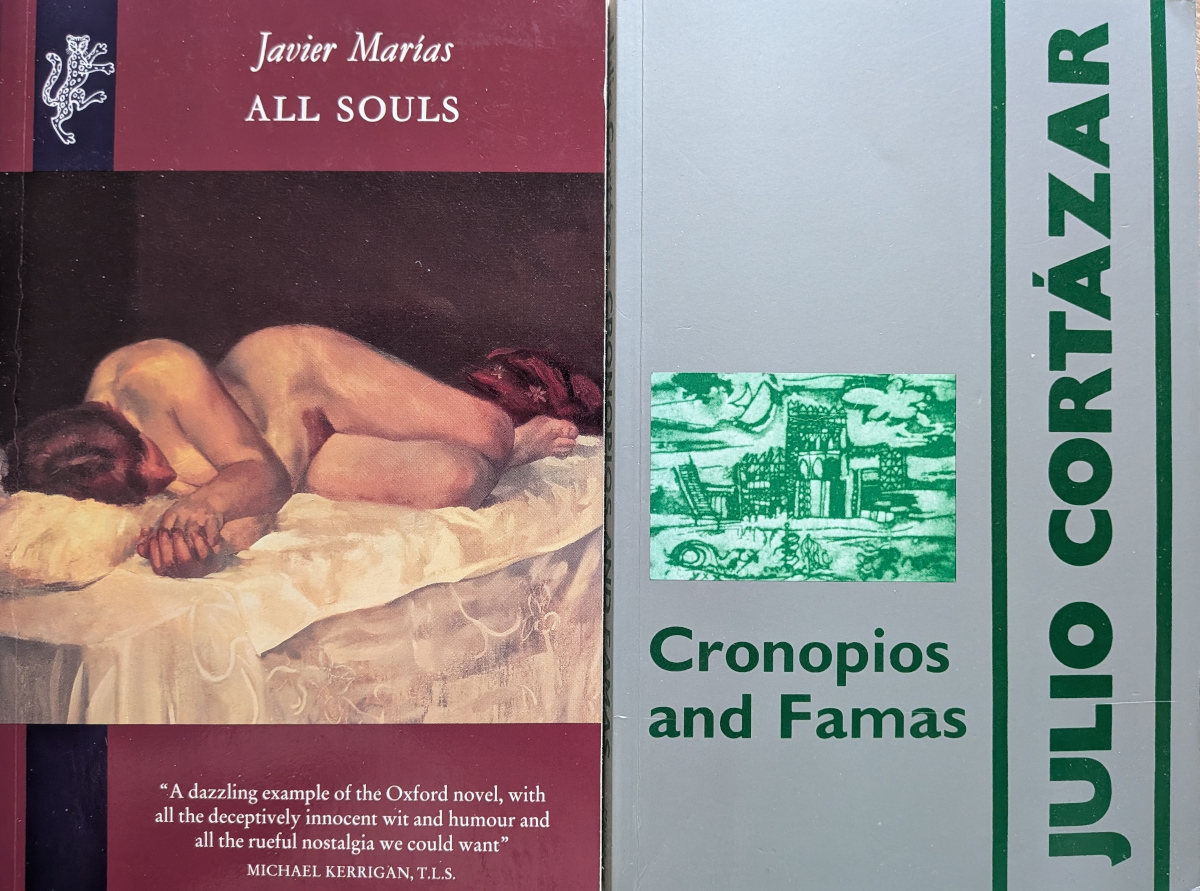
- Cronopios and Famas — Julio Cortázar, tr. Paul Blackburn
- Living Things — Munir Hachemi, tr. Julia Sanches
- So forsch, so furchtlos — Andrea Abreu, tr. Christiane Quandt
- The Man in the Red Coat — Julian Barnes
- The Heart and Other Viscera — Félix J. Palma, tr. Nick Caistor and Lorenza García
- É sempre a hora da nossa morte amém — Mariana Salomão Carrara
- Tears in Rain — Rosa Montero, tr. Lilit Žekulin Thwaites
- All Souls — Javier Marías, tr. Margaret Jull Costa
The Spanish theme was something of an accident: I started with Living Things, and decided to continue from there. This was by some distance the worst of the month’s reads — particularly disappointing as Fitzcarraldos are almost all excellent. The adventures of four overprivileged jerks pretending to be poor for a summer did not enthrall me, and while I know that likeable characters are not essential for a good book, there has to be something that makes me want to spend time with them. In this case there wasn’t. The final reveal was extremely underwhelming, although it did at least signal the end of the book.
So forsch, so furchtlos was a great counterpoint: the characters don’t need to be likeable, because they’re full of life and show the reader a side of life close enough to be fascinating, but remote enough to be unfamiliar. The two main characters are pubescent girls from poor families on the Canary Islands, whose relationship reads like a scurrilous parody of Elena Ferrante: the girls explore bodily functions and fluids largely unhindered by the adults in their lives. The ending again was not great, but the journey there was outstanding.
Another man, another relatively poor book: The Heart and Other Viscera is by an apparently well-known Spanish fantasy writer, though most of the stories here were on the realistic side. A special form of “realistic”, however, in which women have empty heads and curvaceous bodies, which they are only too willing to deliver unto the protagonists who bear a suspicious resemblance to the intended readership. There’s some nice writing in between, but the overall impression of misogyny was not pleasant.
Tears in Rain is a very odd book: a series of murders involving replicants — artificial humans with short lifespans who are used as off-world slaves, but face discrimination on Earth — is investigated by a detective who is herself a replicant. All of which may sound very familiar, and to Montero’s credit she explicitly acknowledges her debt to Blade Runner. The world-building and characters are interesting, particularly the detective (for mysterious reasons named “Bruna Husky”), and I’d like to read others in the series. The very substantial problem is that the psychology of the replicants seems not to have received any thought: with a few years on Earth, they apparently get ordinary jobs and live virtually indistinguishably from humans until their fixed death date.
I read All Souls thirty-odd years ago, and could remember only the general gist and a few details, but nothing of the story. This turns out to be because there isn’t really a story, apart from a very contrived background link which is the climax. The rest of the book is diverting, especially if you know Oxford already, but I’d hoped for a lot more given what others have said about Marías.
My second book of stories for the month was Cronopios and Famas. I almost give up in irritation at the first section (very dated trying to hard to be surreal), but the other three parts were much better — weird enough to keep you on your toes, but old-school enough to actually have stories, of a sort.
Neatly, one of the Cortázar stories is referred to in É sempre a hora da nossa morte amém. This was an intriguing one: it’s told from the point of view of a woman with amnesia, presenting us with mutually inconsistent possible fragments of her life. Thus we get several versions of her daughter’s death, but the emotional effect of each is watered down by the uncertainty whether it’s “real”. The end of the book is less dramatic, but is the more powerful for being some kind of truth.
Barnes of the month was a new one for me: The Man in the Red Coat is a sort of biography of a French doctor who would not be particularly notable now were he not the subject of the Sargent painting of the title, and generally in the centre of the Belle Epoque. This is the real interest — seeing how all the familiar figures related to one another, and all told in the characteristic witty voice.
No Richardson this month — Deadlock is still in progress. I’ve also started on my July project, which will be Hugo award reading — there’s more than I could possibly finish, but I’m hoping at least to manage the novels, novellas, novelettes and stories.